//
··
May 26, 2026
We publish a complete, machine-readable rendering of Euclid's Elements as an rrxiv paper. All thirteen books are encoded: every definition, postulate, common notion, and proposition is registered as an addressable rrxiv claim, and every proof is encoded as a sequence of explicit depends_on edges to earlier claims. The encoding produces 465 propositions, 109 definitions, 5 postulates, and 5 common notions, connected by over a thousand depends_on edges — the full reasoning DAG of the Elements is queryable through the rrxiv API.
The encoding serves three purposes: (i) it dogfoods the rrxiv schema on a finite, dependency-rich corpus that has been studied for two thousand years; (ii) it provides a working reproducibility demonstration — every proposition is provable from claims that the rrxiv graph can enumerate, terminating in the five postulates and five common notions; and (iii) it gives agent harnesses a canonical proof corpus to retrieve over.
Books I, II, and III are written in full Heath-density prose with TikZ figures for the canonical constructions (I.1, I.5, I.32, I.47, II.4, II.11, II.14, III.20, III.31, III.36). Books IV through XIII carry the full statement + dependency-edge DAG with condensed proof sketches; rendering them at Heath density is a long-running editorial project, and PRs at https://github.com/random-walks/rrxiv-paper-euclid-elements are welcome. The translation follows Heath (1908, public domain) with light modernisation; the rrxiv encoding is released under CC-BY-4.0.
To draw a straight line from any point to any point.
To produce a finite straight line continuously in a straight line.
To describe a circle with any centre and distance.
That all right angles are equal to one another.
That, if a straight line falling on two straight lines makes the interior angles on the same side less than two right angles, the two straight lines, if produced indefinitely, meet on that side on which are the angles less than the two right angles.
Things which are equal to the same thing are also equal to one another.
If equals be added to equals, the wholes are equal.
If equals be subtracted from equals, the remainders are equal.
Things which coincide with one another are equal to one another.
The whole is greater than the part.
A point is that which has no part.
A line is breadthless length.
The extremities of a line are points.
A straight line is a line which lies evenly with the points on itself.
A surface is that which has length and breadth only.
The extremities of a surface are lines.
A plane surface is a surface which lies evenly with the straight lines on itself.
A plane angle is the inclination to one another of two lines in a plane which meet one another and do not lie in a straight line.
And when the lines containing the angle are straight, the angle is called rectilineal.
When a straight line set up on a straight line makes the adjacent angles equal to one another, each of the equal angles is right, and the straight line standing on the other is called a perpendicular to that on which it stands.
An obtuse angle is an angle greater than a right angle.
An acute angle is an angle less than a right angle.
A boundary is that which is an extremity of anything.
A figure is that which is contained by any boundary or boundaries.
A circle is a plane figure contained by one line such that all the straight lines falling upon it from one point among those lying within the figure are equal to one another.
And the point is called the centre of the circle.
A diameter of the circle is any straight line drawn through the centre and terminated in both directions by the circumference of the circle, and such a straight line also bisects the circle.
A semicircle is the figure contained by the diameter and the circumference cut off by it. And the centre of the semicircle is the same as that of the circle.
Rectilineal figures are those which are contained by straight lines, trilateral figures being those contained by three, quadrilateral those contained by four, and multilateral those contained by more than four straight lines.
Of trilateral figures, an equilateral triangle is that which has its three sides equal, an isosceles triangle that which has two of its sides alone equal, and a scalene triangle that which has its three sides unequal.
Further, of trilateral figures, a right-angled triangle is that which has a right angle, an obtuse-angled triangle that which has an obtuse angle, and an acute-angled triangle that which has its three angles acute.
Of quadrilateral figures, a square is that which is both equilateral and right-angled; an oblong that which is right-angled but not equilateral; a rhombus that which is equilateral but not right-angled; and a rhomboid that which has its opposite sides and angles equal to one another but is neither equilateral nor right-angled. And let quadrilaterals other than these be called trapezia.
Parallel straight lines are straight lines which, being in the same plane and being produced indefinitely in both directions, do not meet one another in either direction.
Any rectangular parallelogram is said to be contained by the two straight lines containing the right angle.
And in any parallelogrammic area let any one whatever of the parallelograms about its diameter, with the two complements, be called a gnomon.
Equal circles are those whose diameters are equal, or whose radii are equal.
A straight line is said to touch a circle which, meeting the circle and being produced, does not cut the circle.
Circles are said to touch one another which, meeting one another, do not cut one another.
In a circle, straight lines are said to be equally distant from the centre when the perpendiculars drawn to them from the centre are equal.
And that straight line is said to be at a greater distance on which the greater perpendicular falls.
A segment of a circle is the figure contained by a straight line and a circumference of a circle.
An angle of a segment is that contained by a straight line and a circumference of a circle.
An angle in a segment is the angle which, when a point is taken on the circumference of the segment and straight lines are joined from it to the extremities of the straight line which is the base of the segment, is contained by the straight lines so joined.
And, when the straight lines containing the angle cut off an arc, the angle is said to stand upon that arc.
A sector of a circle is the figure which, when an angle is constructed at the centre of the circle, is contained by the straight lines containing the angle and the arc cut off by them.
Similar segments of circles are those which admit equal angles, or in which the angles are equal to one another.
A magnitude is a part of a magnitude, the less of the greater, when it measures the greater.
The greater is a multiple of the less when it is measured by the less.
A ratio is a sort of relation in respect of size between two magnitudes of the same kind.
Magnitudes are said to have a ratio to one another which are capable, when multiplied, of exceeding one another (the Archimedean property).
Magnitudes are said to be in the same ratio, the first to the second and the third to the fourth, when, if any equimultiples whatever be taken of the first and third, and any equimultiples whatever of the second and fourth, the former equimultiples alike exceed, are alike equal to, or alike fall short of, the latter equimultiples respectively taken in corresponding order.
Let magnitudes which have the same ratio be called proportional.
When, of the equimultiples, the multiple of the first magnitude exceeds the multiple of the second, but the multiple of the third does not exceed the multiple of the fourth, then the first is said to have a greater ratio to the second than the third has to the fourth.
A proportion in three terms is the least possible.
When three magnitudes are proportional, the first is said to have to the third the duplicate ratio of that which it has to the second.
When four magnitudes are continuously proportional, the first is said to have to the fourth the triplicate ratio of that which it has to the second, and so on, in continual proportion of any number of magnitudes.
Antecedents are said to correspond to antecedents, and consequents to consequents.
Alternate ratio means taking the antecedent in relation to the antecedent and the consequent in relation to the consequent.
Inverse ratio means taking the consequent as antecedent in relation to the antecedent as consequent.
Composition of a ratio means taking the antecedent together with the consequent as one in relation to the consequent by itself.
Separation of a ratio means taking the excess by which the antecedent exceeds the consequent in relation to the consequent by itself.
Conversion of a ratio means taking the antecedent in relation to the excess by which the antecedent exceeds the consequent.
A ratio ex aequali arises when, there being several magnitudes and another set equal to them in multitude which taken two and two are in the same proportion, as the first is to the last of the first magnitudes, so is the first to the last of the second magnitudes.
A perturbed proportion arises when, there being three magnitudes and another set equal to them in multitude, as antecedent is to consequent among the first magnitudes, so is antecedent to consequent among the second magnitudes, while as the consequent is to a third among the first magnitudes, so is a third to the antecedent among the second magnitudes.
A unit is that by virtue of which each of the things that exist is called one.
A number is a multitude composed of units.
A number is a part of a number, the less of the greater, when it measures the greater.
But parts when it does not measure it.
The greater number is a multiple of the less when it is measured by the less.
An even number is that which is divisible into two equal parts.
An odd number is that which is not divisible into two equal parts, or that which differs by a unit from an even number.
An even-times even number is that which is measured by an even number according to an even number.
An even-times odd number is that which is measured by an even number according to an odd number.
An odd-times odd number is that which is measured by an odd number according to an odd number.
A prime number is that which is measured by a unit alone.
Numbers prime to one another are those which are measured by a unit alone as a common measure.
A composite number is that which is measured by some number.
Numbers composite to one another are those which are measured by some number as a common measure.
A number is said to multiply a number when that which is multiplied is added to itself as many times as there are units in the other, and thus some number is produced.
When two numbers having multiplied one another make some number, the number so produced is called plane, and its sides are the numbers which have multiplied one another.
When three numbers having multiplied one another make some number, the number so produced is solid, and its sides are the numbers which have multiplied one another.
A square number is equal multiplied by equal, or a number which is contained by two equal numbers.
A cube number is equal multiplied by equal and again by equal, or a number which is contained by three equal numbers.
Numbers are proportional when the first is the same multiple, or the same part, or the same parts, of the second that the third is of the fourth.
Similar plane and solid numbers are those which have their sides proportional.
A perfect number is that which is equal to the sum of its own parts (its proper divisors).
Those magnitudes are said to be commensurable which are measured by the same measure, and those incommensurable which cannot have any common measure.
Straight lines are commensurable in square when the squares on them are measured by the same area, and incommensurable in square when the squares on them cannot possibly have any area as a common measure.
With these hypotheses, it is proved that there exist straight lines infinite in multitude which are commensurable and incommensurable respectively, some in length only, and others in square also, with an assigned straight line. Let the assigned straight line be called rational, and those straight lines which are commensurable with it, whether in length and in square or in square only, rational, but those which are incommensurable with it irrational.
And let the square on the assigned straight line be called rational and those areas which are commensurable with it rational, but those which are incommensurable with it irrational, and the straight lines which produce them irrational — that is, in case the areas are squares, the sides themselves; in other cases, the straight lines on which the rectangles equal to the areas would be applied.
Given a rational straight line and a binomial, divided into its terms, let the square of the greater term be greater than the square of the lesser by the square of a straight line commensurable in length with the greater. Then if the greater term is commensurable in length with the assigned rational straight line, the whole is called a first binomial.
If the lesser term is commensurable in length with the assigned rational straight line, the whole is called a second binomial.
If neither term is commensurable in length with the assigned rational straight line, the whole is called a third binomial.
If the square of the greater term exceeds the square of the lesser by the square of a line incommensurable in length with the greater, and the greater term is commensurable in length with the assigned rational straight line, the whole is called a fourth binomial.
If, in the same case, the lesser term is commensurable in length with the assigned rational straight line, the whole is called a fifth binomial.
If neither term is commensurable in length with the assigned rational straight line, the whole is called a sixth binomial.
Given a rational straight line and an apotome (i.e. a difference of two rationals commensurable in square only), if the square of the whole is greater than the square of the annex by the square of a straight line commensurable in length with the whole, and the whole is commensurable in length with the assigned rational straight line, the apotome is called a first apotome.
If the annex is commensurable in length with the assigned rational straight line, the apotome is called a second apotome.
If neither the whole nor the annex is commensurable in length with the assigned rational straight line, the apotome is called a third apotome.
If the square of the whole exceeds the square of the annex by the square of a straight line incommensurable in length with the whole, and the whole is commensurable in length with the assigned rational straight line, the apotome is called a fourth apotome.
If, in the same case, the annex is commensurable in length with the assigned rational straight line, the apotome is called a fifth apotome.
If neither the whole nor the annex is commensurable in length with the assigned rational straight line, the apotome is called a sixth apotome.
A solid is that which has length, breadth, and depth.
An extremity of a solid is a surface.
A straight line is at right angles to a plane when it makes right angles with all the straight lines which meet it and are in the plane.
A plane is at right angles to a plane when the straight lines drawn in one of the planes at right angles to the common section of the planes are at right angles to the remaining plane.
The inclination of a straight line to a plane is, assuming a perpendicular drawn from the extremity of the straight line which is elevated above the plane to the plane and a straight line joined from the foot of the perpendicular to the extremity of the straight line which is in the plane, the angle contained by the straight line so drawn and the straight line standing up.
The inclination of a plane to a plane is the acute angle contained by the straight lines drawn at right angles to the common section at the same point, one in each of the planes.
A plane is said to be similarly inclined to a plane as another to another when the said angles of the inclinations are equal to one another.
Parallel planes are those which do not meet.
Similar solid figures are those contained by similar planes equal in multitude.
Equal and similar solid figures are those contained by similar planes equal in multitude and in magnitude.
A solid angle is the inclination constituted by more than two lines which meet one another and are not in the same surface, towards all the lines. Otherwise: a solid angle is that which is contained by more than two plane angles which are not in the same plane and are constructed to one point.
A pyramid is a solid figure contained by planes which is constructed from one plane to one point.
A prism is a solid figure contained by planes two of which, namely those which are opposite, are equal, similar, and parallel, while the rest are parallelograms.
When a semicircle with fixed diameter is carried round and restored again to the same position from which it began to be moved, the figure so comprehended is a sphere.
The axis of the sphere is the straight line which remains fixed and about which the semicircle is turned.
The centre of the sphere is the same as that of the semicircle.
A diameter of the sphere is any straight line drawn through the centre and terminated in both directions by the surface of the sphere.
When, one side of those about the right angle in a right-angled triangle remaining fixed, the triangle is carried round and restored again to the same position from which it began to be moved, the figure so comprehended is a cone. And if the straight line which remains fixed is equal to the remaining side about the right angle which is carried round, the cone will be right-angled; if less, obtuse-angled; and if greater, acute-angled.
The axis of the cone is the straight line which remains fixed and about which the triangle is turned.
And the base is the circle described by the straight line which is carried round.
When, one side of those about the right angle in a rectangular parallelogram remaining fixed, the parallelogram is carried round and restored again to the same position from which it began to be moved, the figure so comprehended is a cylinder.
The axis of the cylinder is the straight line which remains fixed and about which the parallelogram is turned.
The bases are the circles described by the two sides opposite to one another which are carried round.
Similar cones and cylinders are those in which the axes and the diameters of the bases are proportional.
A cube is a solid figure contained by six equal squares.
An octahedron is a solid figure contained by eight equal and equilateral triangles.
An icosahedron is a solid figure contained by twenty equal and equilateral triangles.
A dodecahedron is a solid figure contained by twelve equal, equilateral, and equiangular pentagons.
A straight line is said to have been cut in extreme and mean ratio when, as the whole line is to the greater segment, so is the greater to the lesser.
The height of any figure is the perpendicular drawn from the vertex to the base.
A medial straight line is the mean proportional between two rational straight lines commensurable in square only.
A minor straight line is the difference of two straight lines incommensurable in square such that the sum of the squares on them is rational, but the rectangle contained by them is medial.
A straight line which produces with a rational area a medial whole is the irrational straight line such that the square on it added to a rational area makes the whole medial.
On a given finite straight line to construct an equilateral triangle.
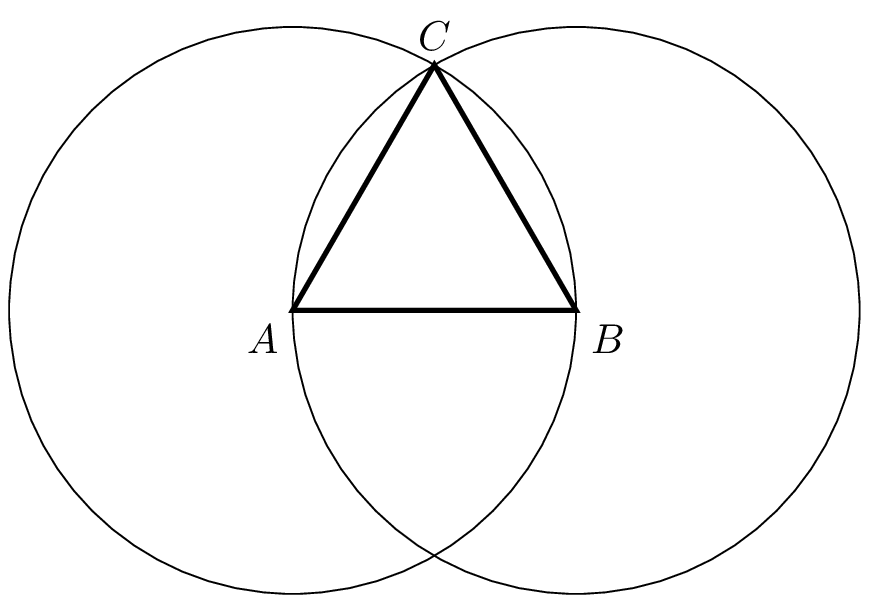
Let be the given finite straight line. With centre
To place at a given point (as an extremity) a straight line equal to a given straight line.
Apply I.1 to obtain an equilateral triangle; produce its sides (Postulate 2); describe a circle with centre at one endpoint of the given segment cutting one of the produced sides; the cut-off equals the given segment by Definition I.15 and Common Notion 1.
I.1Postulate 1Postulate 2Postulate 3Definition I.15Common notion 1Given two unequal straight lines, to cut off from the greater a straight line equal to the less.
Use I.2 to construct, at one extremity of the longer line, a segment equal to the shorter. Then by Definition I.15 the desired cut-off is obtained.
I.2Definition I.15If two triangles have two sides equal to two sides respectively, and have the angles contained by the equal straight lines equal, then they will also have the base equal to the base, the triangle will be equal to the triangle, and the remaining angles will be equal to the remaining angles respectively.
Superpose one triangle on the other; corresponding sides and angles coincide; by Common Notion 4 the figures are equal.
Common notion 4In isosceles triangles the angles at the base are equal to one another; and if the equal straight lines be produced further, the angles under the base will be equal to one another.
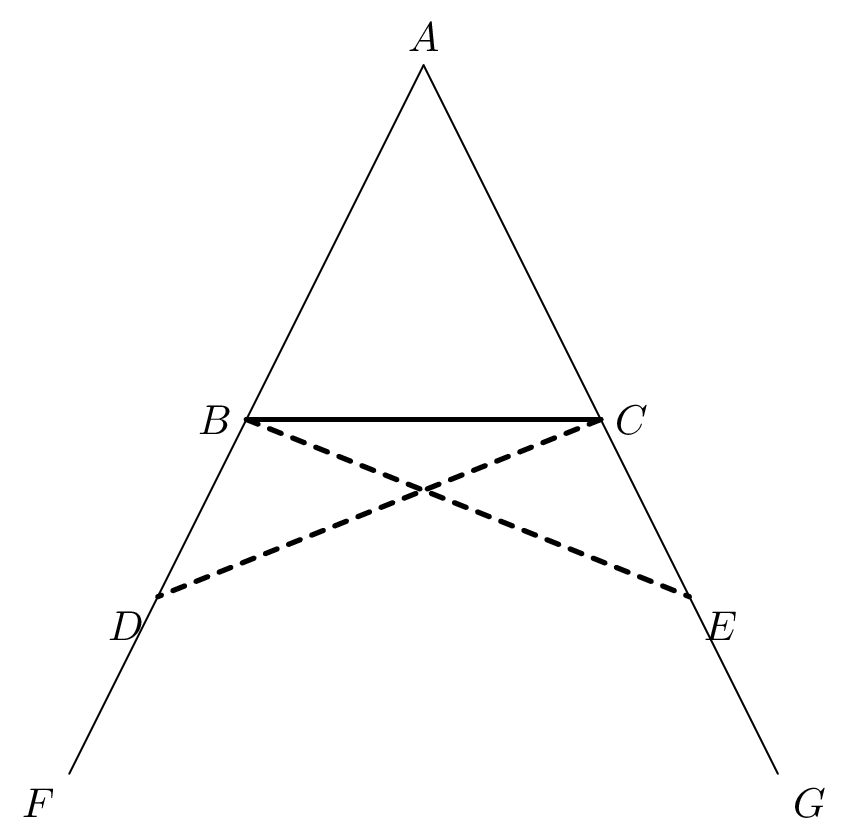
If in a triangle two angles are equal to one another, the sides which subtend the equal angles will also be equal to one another.
Suppose the sides unequal; cut off (by I.3) the greater equal to the less; by I.4 the resulting smaller triangle equals the whole, which contradicts Common Notion 5. Therefore the sides are equal.
I.3I.4Common notion 5Given two straight lines constructed on a straight line and meeting in a point, there cannot be constructed on the same straight line and on the same side of it two other straight lines meeting in another point and equal to the former two respectively, namely each to that which has the same extremity with it.
A double application of I.5 yields contradictory angle equalities; by Common Notion 5 the second meeting point cannot exist.
I.5Common notion 5If two triangles have the two sides equal to two sides respectively, and have also the base equal to the base, they will also have the angles equal which are contained by the equal straight lines.
Superpose and apply I.7 to rule out a non-coincident image of the contained angle; conclude by Common Notion 4.
I.7Common notion 4To bisect a given rectilineal angle.
Apply I.1 to construct an equilateral triangle on a chord between the angle's sides; the line from the vertex to the equilateral's apex bisects the angle by I.8.
I.1I.8To bisect a given finite straight line.
Apply I.1 to erect an equilateral triangle on the segment; bisect the opposite angle by I.9; the bisector meets the segment at its midpoint by I.4.
I.1I.9I.4To draw a straight line at right angles to a given straight line from a given point on it.
Apply I.3 to mark equal segments either side of the given point, then I.1 to erect an equilateral triangle whose apex line is perpendicular (by I.8 and Definition I.10).
I.1I.3I.8Definition I.10To draw a perpendicular straight line to a given infinite straight line from a given point not on it.
With centre at the external point describe a circle (Postulate 3) cutting the given line; bisect the chord by I.10; the line from the external point to the midpoint is perpendicular by I.8.
I.8I.10Postulate 3If a straight line set up on a straight line make angles, it will make either two right angles or angles equal to two right angles.
Drop a perpendicular by I.11; Common Notions 1–2 sum the resulting two right angles to the unequal-case angle sum.
I.11Common notion 1Common notion 2Definition I.10If with any straight line, and at a point on it, two straight lines not lying on the same side make the adjacent angles equal to two right angles, the two straight lines will be in a straight line with one another.
Suppose not; then I.13 and Common Notion 1 yield contradictory angle sums.
I.13Common notion 1If two straight lines cut one another, they make the vertical angles equal to one another.
Apply I.13 twice and Common Notion 3.
I.13Common notion 3In any triangle, if one of the sides be produced, the exterior angle is greater than either of the interior and opposite angles.
Bisect a side by I.10; produce a median; apply I.4 to obtain a congruent triangle that has the interior angle as one of its parts; Common Notion 5 closes the inequality.
I.4I.10Common notion 5In any triangle two angles taken together in any manner are less than two right angles.
Apply I.16 and I.13.
I.13I.16In any triangle the greater side subtends the greater angle.
Cut off (I.3) a segment on the greater side equal to the lesser; apply I.5 and I.16.
I.3I.5I.16In any triangle the greater angle is subtended by the greater side.
Suppose not; by I.5 and I.18 contradiction.
I.5I.18In any triangle two sides taken together in any manner are greater than the remaining one.
Produce one side to an isosceles configuration by I.3; apply I.5 and I.19.
I.3I.5I.19If on one of the sides of a triangle, from its extremities, there be constructed two straight lines meeting within the triangle, the straight lines so constructed will be less than the remaining two sides of the triangle, but will contain a greater angle.
Two applications of I.20 and one of I.16.
I.16I.20Out of three straight lines, which are equal to three given straight lines, to construct a triangle: thus it is necessary that two of the straight lines taken together in any manner should be greater than the remaining one.
Apply I.20 (the necessity), then I.3 and Postulate 3 (the construction).
I.3I.20Postulate 3On a given straight line and at a point on it to construct a rectilineal angle equal to a given rectilineal angle.
Cut equal segments by I.3, construct the matching triangle by I.22, apply I.8.
I.3I.8I.22If two triangles have the two sides equal to two sides respectively, but have the one of the angles contained by the equal straight lines greater than the other, they will also have the base greater than the base.
Apply I.23, I.4, I.5, and I.19.
I.4I.5I.19I.23If two triangles have the two sides equal to two sides respectively, but have the one base greater than the other, they will also have the one angle contained by the equal straight lines greater than the other.
Suppose not and use I.4, I.24.
I.4I.24If two triangles have the two angles equal to two angles respectively, and one side equal to one side, namely either the side adjoining the equal angles or that subtending one of the equal angles, they will also have the remaining sides equal to the remaining sides and the remaining angle equal to the remaining angle.
Apply I.4 to the congruent angle–side–angle case; for the AAS case combine I.4 with I.16.
I.4I.16If a straight line falling on two straight lines make the alternate angles equal to one another, the straight lines will be parallel to one another.
Suppose the lines meet; I.16 gives a contradiction. By Definition I.23 they are parallel.
I.16Definition I.23If a straight line falling on two straight lines make the exterior angle equal to the interior and opposite angle on the same side, or the interior angles on the same side equal to two right angles, the straight lines will be parallel to one another.
Reduce to I.27 via I.13 and I.15.
I.13I.15I.27A straight line falling on parallel straight lines makes the alternate angles equal to one another, the exterior angle equal to the interior and opposite angle, and the interior angles on the same side equal to two right angles.
The first use of Postulate 5: any contrary supposition contradicts the parallel postulate via I.13.
I.13Postulate 5Straight lines parallel to the same straight line are also parallel to one another.
Two applications of I.29 and Common Notion 1.
I.29Common notion 1Through a given point to draw a straight line parallel to a given straight line.
Apply I.23 to reproduce the alternate angle at the given point and I.27 to conclude parallelism.
I.23I.27In any triangle, if one of the sides be produced, the exterior angle is equal to the two interior and opposite angles, and the three interior angles of the triangle are equal to two right angles.
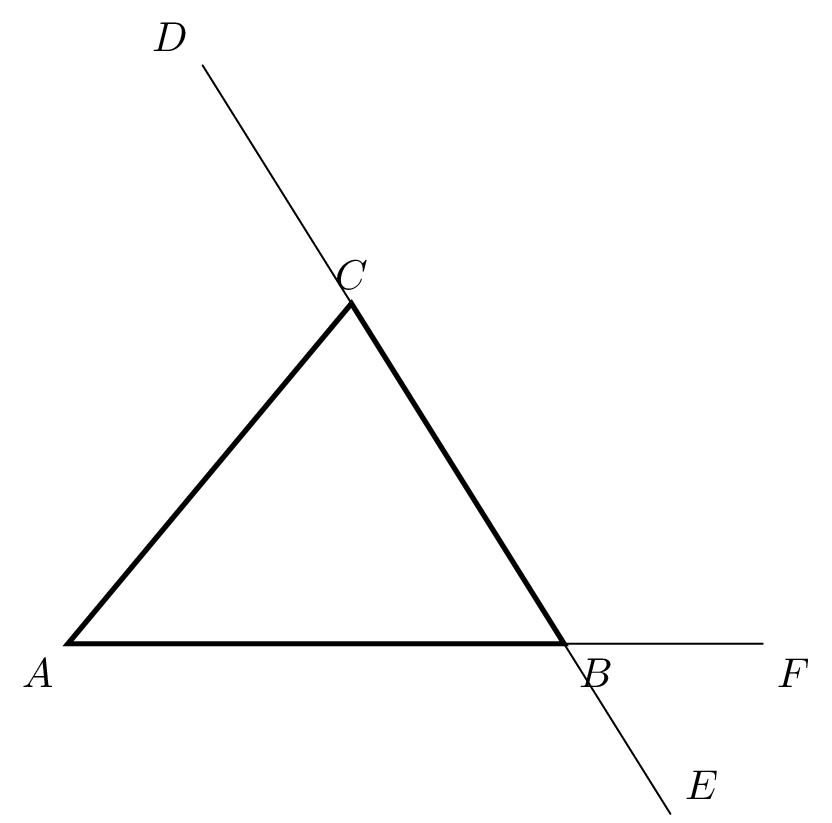
The straight lines joining equal and parallel straight lines (at the extremities which are in the same directions) are themselves equal and parallel.
Apply I.4 to the resulting two triangles and I.29 + I.27 for parallelism.
I.4I.27I.29In parallelogrammic areas the opposite sides and angles are equal to one another, and the diameter bisects the areas.
Apply I.29 and I.26 to the two triangles cut by the diameter, then Common Notion 2.
I.26I.29Common notion 2Parallelograms which are on the same base and in the same parallels are equal to one another.
Apply I.34 and I.4 to congruent triangles; conclude by Common Notions 2–3.
I.4I.34Common notion 2Common notion 3Parallelograms which are on equal bases and in the same parallels are equal to one another.
Translate one parallelogram via I.33 to share a base with the other, then apply I.35.
I.33I.35Triangles which are on the same base and in the same parallels are equal to one another.
Complete each triangle to a parallelogram via I.31, then apply I.34 and I.35.
I.31I.34I.35Triangles which are on equal bases and in the same parallels are equal to one another.
Same construction as I.37 with I.36 in place of I.35.
I.31I.34I.36Equal triangles which are on the same base and on the same side are also in the same parallels.
Apply I.31 to draw a parallel; I.37 forces the second vertex onto it.
I.31I.37Equal triangles which are on equal bases and on the same side are also in the same parallels.
Same approach as I.39 with I.38 in place of I.37.
I.31I.38If a parallelogram have the same base with a triangle and be in the same parallels, the parallelogram is double of the triangle.
Apply I.34 and I.37; double via Common Notion 2.
I.34I.37Common notion 2To construct, in a given rectilineal angle, a parallelogram equal to a given triangle.
Bisect a side by I.10; apply I.23 to set the angle; apply I.31 and I.41.
I.10I.23I.31I.41In any parallelogram the complements of the parallelograms about the diameter are equal to one another.
Apply I.34 to the bisecting diameter and Common Notions 2–3.
I.34Common notion 2Common notion 3To a given straight line to apply, in a given rectilineal angle, a parallelogram equal to a given triangle.
Apply I.42 and I.43 in sequence.
I.42I.43To construct, in a given rectilineal angle, a parallelogram equal to a given rectilineal figure.
Triangulate the figure; sum the parallelograms by repeated I.44 and Common Notion 2.
I.44Common notion 2On a given straight line to describe a square.
Apply I.11 to erect perpendiculars; use I.3 to cut off equal segments; use I.31 and I.29 to close the square; verify right angles via I.34.
I.3I.11I.29I.31I.34In right-angled triangles the square on the side subtending the right angle is equal to the squares on the sides containing the right angle.
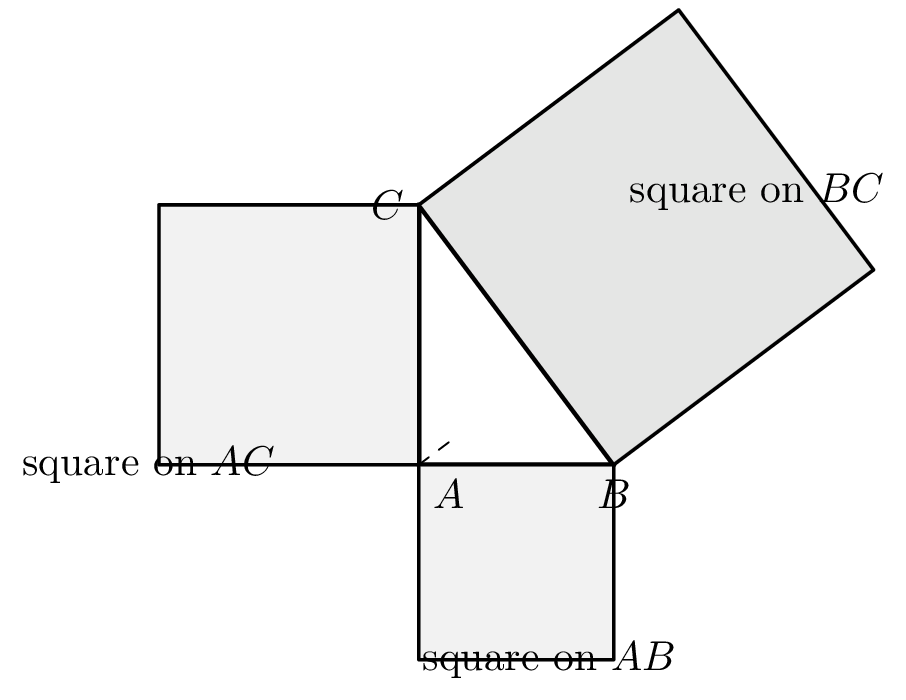
If in a triangle the square on one of the sides be equal to the squares on the remaining two sides of the triangle, the angle contained by the remaining two sides of the triangle is right.
Construct a right triangle with the same two legs by I.11; apply I.47, I.8, and Common Notion 1.
I.8I.11I.47Common notion 1If there be two straight lines, and one of them be cut into any number of segments whatever, the rectangle contained by the two straight lines is equal to the rectangles contained by the uncut straight line and each of the segments.
Let and be the two straight lines, and let be cut at random at the points , . Construct the rectangle contained by and as follows. From draw
If a straight line be cut at random, the rectangle contained by the whole and both of the segments is equal to the square on the whole.
Let the straight line be cut at random at the point . Describe on the square (I.46), and through draw parallel to either or
If a straight line be cut at random, the rectangle contained by the whole and one of the segments is equal to the rectangle contained by the segments and the square on the aforesaid segment.
Let be cut at ; consider the rectangle on , . By Proposition II.1, taking as the uncut line and the two segments , of
If a straight line be cut at random, the square on the whole is equal to the squares on the segments and twice the rectangle contained by the segments.
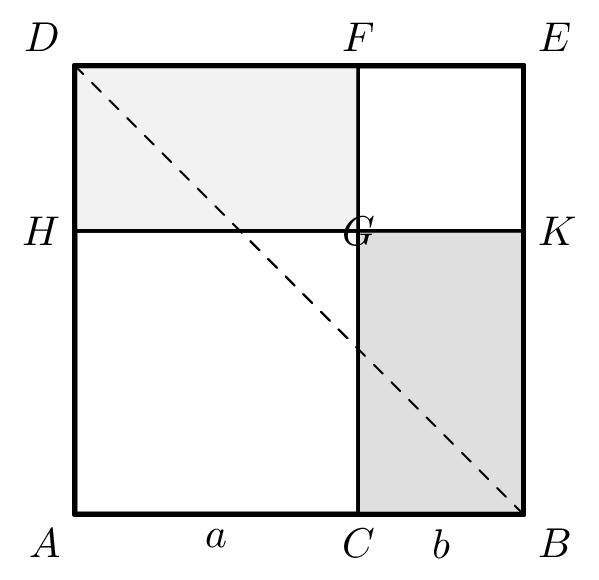
If a straight line be cut into equal and unequal segments, the rectangle contained by the unequal segments of the whole together with the square on the straight line between the points of section is equal to the square on the half.
Let be bisected at (I.10) and cut unequally at . Describe on the square (I.46), join , and through draw
If a straight line be bisected and a straight line be added to it in a straight line, the rectangle contained by the whole with the added straight line and the added straight line, together with the square on the half, is equal to the square on the straight line made up of the half and the added straight line.
Let be bisected at (I.10) and produced to , so that is the half plus the added segment . Describe on the square (I.46), join
If a straight line be cut at random, the square on the whole and that on one of the segments both together are equal to twice the rectangle contained by the whole and the said segment together with the square on the remaining segment.
Let be cut at . Describe on the square (I.46), and through draw parallel to or
If a straight line be cut at random, four times the rectangle contained by the whole and one of the segments together with the square on the remaining segment is equal to the square described on the whole and the aforesaid segment as on one straight line.
Let be cut at , and produce to so that . Then
If a straight line be cut into equal and unequal segments, the squares on the unequal segments of the whole are double of the square on the half and of the square on the straight line between the points of section.
Let be bisected at (I.10) and cut unequally at . At draw at right angles to (I.11), with
If a straight line be bisected and a straight line be added to it in a straight line, the square on the whole with the added straight line and the square on the added straight line both together are double of the square on the half and of the square described on the straight line made up of the half and the added straight line as on one straight line.
Let be bisected at (I.10) and produced to . At erect at right angles to (I.11), with
To cut a given straight line so that the rectangle contained by the whole and one of the segments is equal to the square on the remaining segment.
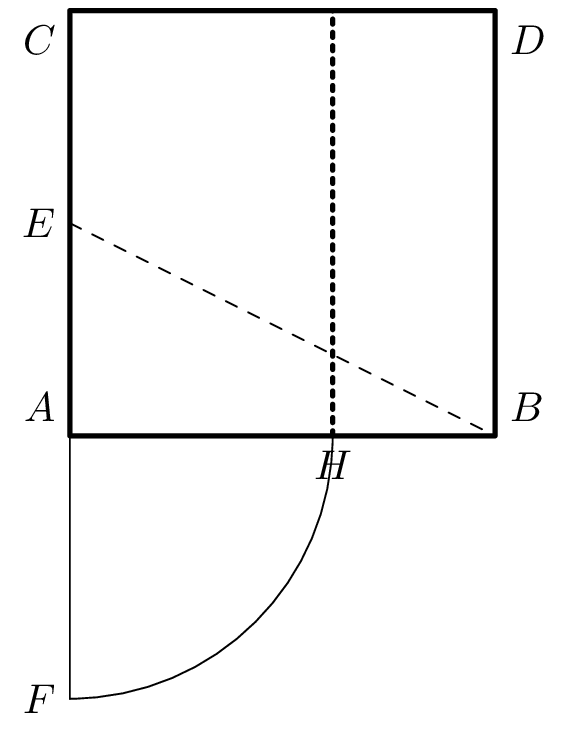
In obtuse-angled triangles the square on the side subtending the obtuse angle is greater than the squares on the sides containing the obtuse angle by twice the rectangle contained by one of the sides about the obtuse angle (namely that on which the perpendicular falls) and the straight line cut off outside by the perpendicular.
Let have an obtuse angle at , and let be the vertex opposite a side about the obtuse angle. From drop a perpendicular to extended through
In acute-angled triangles the square on the side subtending the acute angle is less than the squares on the sides containing the acute angle by twice the rectangle contained by one of the sides about the acute angle (namely that on which the perpendicular falls) and the straight line cut off within by the perpendicular.
Let be acute-angled, with the acute angle at . From drop a perpendicular to (I.12). Since the angle at is acute, the foot falls within the segment
To construct a square equal to a given rectilineal figure.
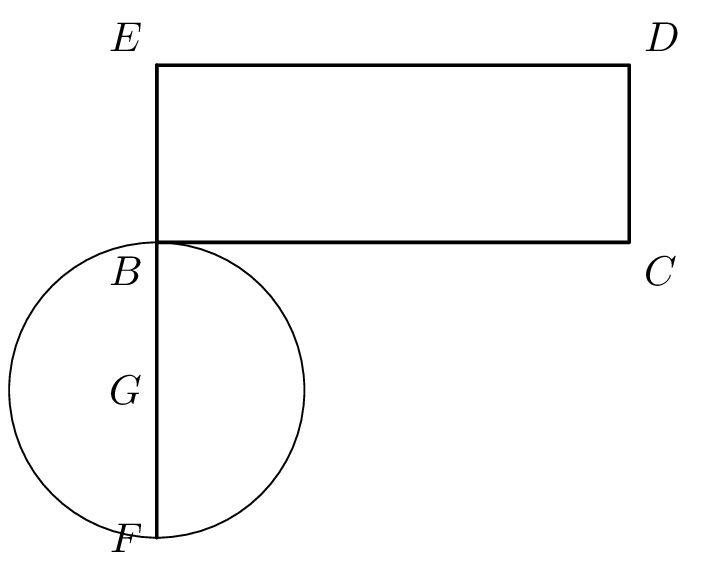
To find the centre of a given circle.
Let be the given circle. Draw any chord in it (Postulate 1) and bisect at (I.10). From draw at right angles to (I.11), produced to meet the circle at
If on the circumference of a circle two points be taken at random, the straight line joining the points will fall within the circle.
Let , be on the circle with centre (III.1). Suppose for contradiction that some point on the chord lies outside the circle; then . Join ,
If in a circle a straight line through the centre bisect a straight line not through the centre, it also cuts it at right angles; and if it cut it at right angles, it also bisects it.
Let be a chord not through the centre , and a line through meeting at . Suppose bisects
If in a circle two straight lines cut one another which are not through the centre, they do not bisect one another.
Let , be two chords intersecting at , neither through the centre . Suppose for contradiction that bisects both: and
If two circles cut one another, they will not have the same centre.
Let circles and meet at points and . Suppose they share centre . Then
If two circles touch one another, they will not have the same centre.
By the same argument as III.5: a shared centre and a common point on the circumference of both circles force equal radii, hence coincident circles.
III.5Definition I.15Definition III.3If on the diameter of a circle a point be taken which is not the centre, and from the point straight lines fall upon the circle: that will be greatest on which the centre is, the remainder of the same diameter will be least, and of the rest the nearer to the diameter through the centre is always greater than the more remote.
Let be a diameter of circle with centre , and let on be distinct from . From draw lines
If a point be taken outside a circle and from the point straight lines be drawn through to the circle, one of which is through the centre and the others fall on the circle: of the lines falling on the concave circumference, that through the centre is greatest, and the nearer to it always greater than the more remote; and of those falling on the convex circumference, that between the point and the diameter is least, and the nearer to it always less than the more remote.
The argument mirrors III.7 with the point outside. Let be the external point and the line through and the centre , meeting the circle at (near) and (far). For any other line from meeting the circle at (near) and
If a point be taken within a circle, and more than two equal straight lines fall from the point on the circle, the point taken is the centre of the circle.
Let be the point and , , three equal lines to the circle. Join , ; bisect them at ,
A circle does not cut a circle at more points than two.
Suppose two circles meet at three points , , . By III.9, the centre of each circle is the unique point equidistant from any three points on its circumference — so both circles have the same centre. Then by III.5 they coincide, contradicting their being two distinct circles.
III.5III.9If two circles touch one another internally, and their centres be taken, the straight line joining their centres, if produced, will fall on the point of contact of the circles.
Let circle contain circle , touching at , with centres (of
If two circles touch one another externally, the straight line joining their centres will pass through the point of contact.
Analogous to III.11. For externally tangent circles, the point of contact lies on the segment between the centres, and exactly. The triangle inequality I.20 then forces to lie on the line .
III.11I.20Definition III.3A circle does not touch a circle at more points than one, whether it touch it internally or externally.
Suppose two circles touch at two points , . By III.11 (internal) or III.12 (external), both and lie on the line joining the centres. Thus this line cuts each circle in two points, making it a diameter of each. But then is a chord of each circle equal in length to the diameter — so and are antipodal points on each circle, and both circles share centre and diameter, contradicting III.5/III.6.
III.5III.6III.11In a circle equal straight lines are equally distant from the centre, and those which are equally distant from the centre are equal to one another.
Let and be chords with . From the centre drop perpendiculars to and
Of straight lines in a circle the diameter is greatest, and of the rest the nearer to the centre is always greater than the more remote.
Let be a diameter, and any other chord. From the centre drop (I.12). By III.3, is the midpoint of , so
The straight line drawn at right angles to the diameter of a circle from its extremity will fall outside the circle, and into the space between the straight line and the circumference another straight line cannot be interposed.
Let be a diameter and drawn at right angles to at (I.11). Suppose meets the circle at another point ; join . Since
From a given point to draw a straight line touching a given circle.
Let be the external point and the circle with centre . Join , and at erect a perpendicular to (I.11); with as centre and
If a straight line touch a circle, and a straight line be joined from the centre to the point of contact, the straight line so joined will be perpendicular to the tangent.
Let line touch the circle at , with centre . Suppose is not perpendicular to ; drop the perpendicular to at some point
If a straight line touch a circle, and from the point of contact a straight line be drawn at right angles to the tangent, the centre of the circle will be on the straight line so drawn.
By III.18, the line from the centre to the contact point is perpendicular to the tangent. Conversely, the perpendicular at the contact point in the plane is unique (I.11), so the centre must lie on it. (If the centre were off this perpendicular, the line from centre to contact would not be perpendicular to the tangent, contradicting III.18.)
III.18I.11Definition III.2In a circle the angle at the centre is double of the angle at the circumference, when the angles have the same circumference as base.
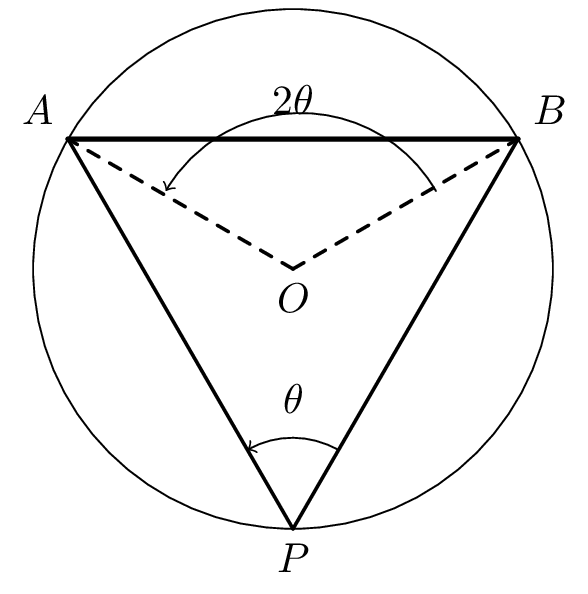
Let be the angle at the centre and
In a circle the angles in the same segment are equal to one another.
Let and both stand on arc from points , on the opposite arc. By III.20 each equals half the central angle , so
The opposite angles of quadrilaterals in circles are equal to two right angles.
Let be a cyclic quadrilateral. Join and . By III.21, (both subtend arc from the opposite side), and
On the same straight line there cannot be constructed two similar and unequal segments of circles on the same side.
Suppose two similar but unequal segments are constructed on the same chord on the same side. Pick a point on the smaller segment's arc. The inscribed angle in the smaller segment equals (by Definition III.11) the inscribed angle in the larger segment, since the segments are similar. But the larger segment's arc lies entirely outside the smaller's arc (different sizes, same chord, same side), so an inscribed angle at a point on the smaller arc as viewed from a point on the larger arc would have to differ from the corresponding inscribed angle in the larger segment (by III.21 they all agree within each segment) — the configurations are incompatible. The two segments must coincide.
III.21Definition III.11Similar segments of circles on equal straight lines are equal to one another.
Apply one segment onto the other via superposition (the device used in I.4): the equal chords coincide, and the equal inscribed angles (Definition III.11) force the arcs to coincide as well. By III.23, two similar segments on the same chord on the same side cannot differ; hence the segments are equal.
III.23I.4Definition III.11Given a segment of a circle, to describe the complete circle of which it is a segment.
Let be the given segment with chord and arc through . Pick on the arc; join , . Bisect at
In equal circles equal angles stand on equal circumferences, whether they stand at the centres or at the circumferences.
Let two equal circles have equal central angles and . In radius-chord-radius triangles and :
In equal circles angles standing on equal circumferences are equal to one another, whether they stand at the centres or at the circumferences.
Converse of III.26. Equal arcs subtend equal chords (apply the superposition argument in reverse), and equal chords in equal circles give equal central angles (I.8: SSS on the radius-chord- radius triangles). Inscribed angles inherit via III.20.
III.20III.26I.8Definition III.1In equal circles equal straight lines cut off equal circumferences, the greater equal to the greater and the less to the less.
Let and be equal chords in equal circles with centres , . In and :
In equal circles equal circumferences are subtended by equal straight lines.
Converse of III.28. Equal arcs give equal central angles (III.27), and equal central angles in equal-radius triangles give equal chords (I.4 SAS).
III.27I.4Definition III.1To bisect a given arc.
Let be the given arc with chord . Bisect at (I.10). At erect (I.11), meeting the arc at . Join
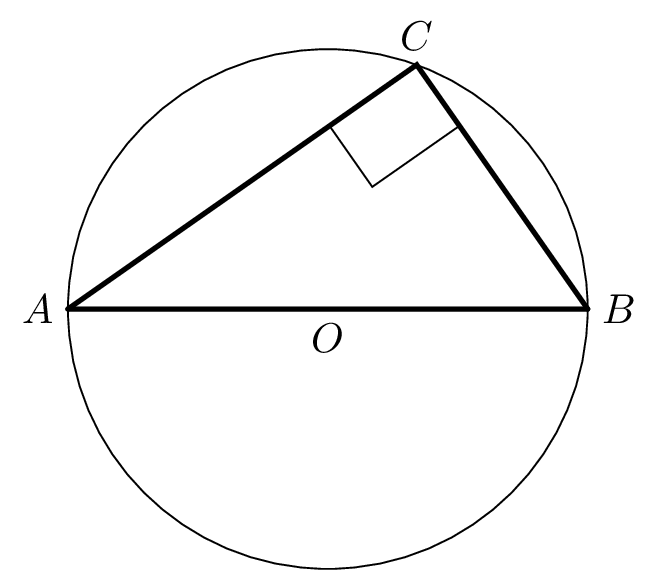
In a circle the angle in the semicircle is right, that in a greater segment less than a right angle, and that in a less segment greater than a right angle.
If a straight line touch a circle, and from the point of contact there be drawn across, in the circle, a straight line cutting the circle, the angles which it makes with the tangent will be equal to the angles in the alternate segments of the circle.
Let touch the circle at , and be a chord from into the circle. We show equals the inscribed angle in the alternate segment .
Draw the diameter from
On a given straight line to describe a segment of a circle admitting an angle equal to a given rectilineal angle.
Let be the given line and $ABAD = A
From a given circle to cut off a segment admitting an angle equal to a given rectilineal angle.
Let the circle and angle $BCB
If in a circle two straight lines cut one another, the rectangle contained by the segments of the one is equal to the rectangle contained by the segments of the other.
Let chords and meet at inside the circle with centre . Let be the midpoint of and of
If a point be taken outside a circle and from it there fall on the circle two straight lines, and if one of them cut the circle and the other touch it, the rectangle contained by the whole of the straight line which cuts the circle and the straight line intercepted on it outside between the point and the convex circumference will be equal to the square on the tangent.
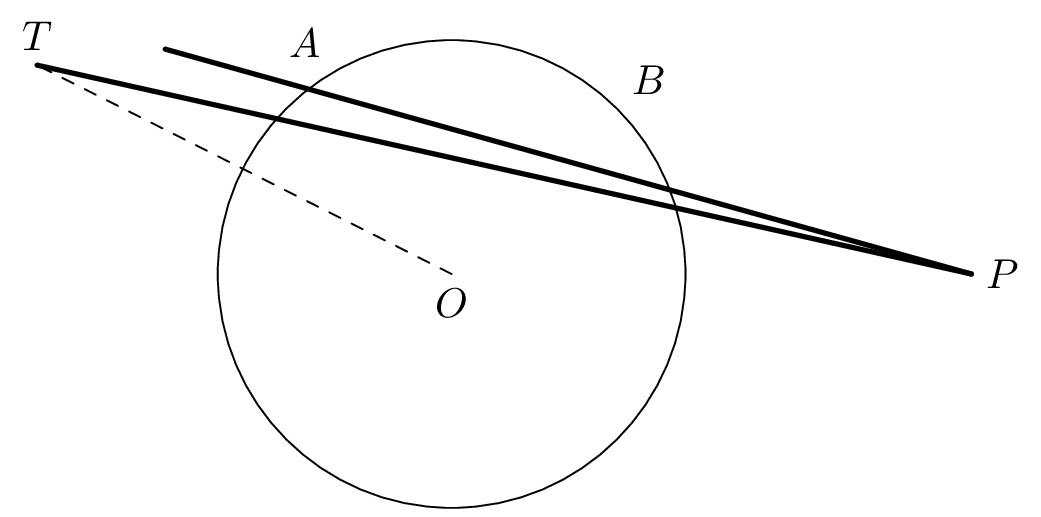
If a point be taken outside a circle and from the point there fall on the circle two straight lines, if one of them cut the circle, and the other fall on it, and if further the rectangle contained by the whole of the straight line which cuts the circle and the straight line intercepted on it outside between the point and the convex circumference be equal to the square on the straight line which falls on the circle, the straight line which falls on it will touch the circle.
Let be the external point, the secant ( near, far), and the straight line falling on the circle at , with
Into a given circle to fit a straight line equal to a given straight line which is not greater than the diameter of the circle.
Let be the given circle and the given segment, not greater than the diameter of the circle. Apply I.3 to cut off from a segment equal to . With centre and radius
In a given circle to inscribe a triangle equiangular with a given triangle.
Let be the given circle and the given triangle. Draw the tangent at any point of the circle (III.16, III.17). On construct (I.23), and
About a given circle to circumscribe a triangle equiangular with a given triangle.
Let be the given circle with centre and the given triangle. Produce both ways to , . At the centre construct
In a given triangle to inscribe a circle.
Let be the given triangle. Bisect and by and (I.9), meeting at . Drop perpendiculars ,
About a given triangle to circumscribe a circle.
Let be the given triangle. Bisect at and at (I.10). From and draw perpendiculars to
In a given circle to inscribe a square.
Let be the given circle with centre . Draw two diameters and at right angles (I.11). Join , , ,
About a given circle to circumscribe a square.
Draw two perpendicular diameters of the given circle (I.11). Through each endpoint draw the tangent to the circle (III.16). Each tangent is perpendicular to its diameter (III.18); the four tangents thus form a quadrilateral with all sides parallel and all angles right (I.28, I.29). Equal radii combined with I.34 force the sides equal, hence a square circumscribes the circle.
I.11I.28I.29I.34III.16III.18In a given square to inscribe a circle.
Let be the given square. Bisect the sides at , , , (I.10). Join and , meeting at
About a given square to circumscribe a circle.
Join the diagonals and of the given square, intersecting at . In the right triangles and , SSS (I.8) gives , so
To construct an isosceles triangle having each of the angles at the base double of the remaining one.
Take a straight line and cut it at so that the rectangle on , equals the square on (II.11, the golden section). With centre and radius describe a circle; in it apply chord
In a given circle to inscribe an equilateral and equiangular pentagon.
Construct the 72–72–36 isosceles triangle by IV.10. Inscribe in the given circle a triangle equiangular with (IV.2). Bisect the base-angles of by IV.10's construction propagated into the circle, yielding two more division points , . The five arcs are equal (III.26), so the five chords
About a given circle to circumscribe an equilateral and equiangular pentagon.
Inscribe a regular pentagon in the given circle by IV.11. At each vertex draw the tangent (III.16); the five tangents bound the circumscribed pentagon. Each tangent is perpendicular to its radius (III.18), and by I.4 the right triangles formed at adjacent vertices are congruent, so the circumscribed pentagon has equal sides and equal angles.
IV.11I.4III.16III.18In a given pentagon, which is equilateral and equiangular, to inscribe a circle.
Bisect two adjacent interior angles of the pentagon (I.9); their bisectors meet at a point . Drop perpendiculars from to each side (I.12); by I.4 these perpendiculars are equal. The circle on with that common radius touches every side (III.16).
I.4I.9I.12III.16About a given pentagon, which is equilateral and equiangular, to circumscribe a circle.
Take the same point as in IV.13 (intersection of two angle-bisectors). Join to each vertex; by I.4 the resulting triangles are congruent (equal sides, common bisected angles), so the five distances from to the vertices are equal. Draw the circle on with that radius (Definition I.15).
IV.13I.4Definition I.15In a given circle to inscribe an equilateral and equiangular hexagon.
Let be the centre and a diameter of the given circle. With centre and radius describe a circle meeting the given circle at and (Postulate 3). Join , . The triangle
In a given circle to inscribe a fifteen-angled figure which shall be both equilateral and equiangular.
Inscribe a regular pentagon (IV.11) and a regular equilateral triangle (IV.2) in the circle, sharing a common vertex . The arc from to the next pentagon-vertex is of the circle; the arc from to the next triangle-vertex is . The difference is of the circle. Bisect that arc (III.30); each half is
If there be any number of magnitudes whatever which are, respectively, equimultiples of any magnitudes equal in multitude, then, whatever multiple one of the magnitudes is of one, that multiple also will all be of all.
Each magnitude is a sum of copies of the corresponding base magnitude. Sum across the magnitudes; by Common Notion 2 the total is copies of the sum.
Common notion 2Definition V.2If a first magnitude be the same multiple of a second that a third is of a fourth, and a fifth also be the same multiple of the second that a sixth is of the fourth, then the sum of the first and fifth will also be the same multiple of the second that the sum of the third and sixth is of the fourth.
If and , and , then
If a first magnitude be the same multiple of a second that a third is of a fourth, and if equimultiples be taken of the first and third, they will also be equimultiples respectively, the one of the second and the other of the fourth.
If and , then and by iterated application of V.1.
V.1Definition V.2If a first magnitude have to a second the same ratio as a third to a fourth, any equimultiples whatever of the first and third will also have the same ratio to any equimultiples whatever of the second and fourth respectively, taken in corresponding order.
By definition V.5, the original proportion gives an equimultiple relation across all multipliers. Substituting for and for throughout simply rescales the test multipliers; the test itself still passes for the rescaled magnitudes.
V.3Definition V.5If a magnitude be the same multiple of a magnitude that a subtracted part is of a subtracted part, the remainder also will be the same multiple of the remainder that the whole is of the whole.
If and with , then
If two magnitudes be equimultiples of two magnitudes, and any magnitudes subtracted from them be equimultiples of the same, the remainders also are either equal to the same or equimultiples of them.
With , , and subtractions ,
Equal magnitudes have to the same the same ratio, as also has the same to equal magnitudes.
Let and arbitrary. For any equimultiples , of , , and of , the test of V.5 succeeds vacuously because
Of unequal magnitudes the greater has to the same a greater ratio than the less has, and the same has to the less a greater ratio than it has to the greater.
Let . Pick a multiplier such that (the Archimedean property of magnitudes, Definition V.4) and an such that falls between and
Magnitudes which have the same ratio to the same are equal to one another; and magnitudes to which the same has the same ratio are equal.
Contrapositive of V.8: if , then . Hence if then . Same argument with
Of magnitudes which have a ratio to the same, that which has a greater ratio is greater; and that to which the same has a greater ratio is less.
Same contrapositive of V.8: if then , since if then by V.7 or V.8 applied in reverse.
Ratios which are the same with the same ratio are also the same with one another.
If and , then for any equimultiples the same inequality test holds for as for
If any number of magnitudes be proportional, as one of the antecedents is to one of the consequents, so will all the antecedents be to all the consequents.
Let all equal in the sense of Definition V.5. For any test multipliers , the sign of
If a first magnitude have to a second the same ratio as a third to a fourth, and the third have to the fourth a greater ratio than a fifth has to a sixth, the first will also have to the second a greater ratio than the fifth to the sixth.
Combine V.11 (sameness transitivity) with Definition V.7 (greater ratio): the witness equimultiples for work for via the V.5 sameness of and
If a first magnitude have to a second the same ratio as a third to a fourth, and the first be greater than the third, the second will also be greater than the fourth; and if equal, equal; and if less, less.
By V.8 and V.13: if , then . Combined with (the hypothesis), V.13 gives
Parts have the same ratio as the same multiples of them taken in corresponding order.
If and , group the copies of and in parallel. Each parallel pair
If four magnitudes be proportional, they will also be proportional alternately.
Let . Test against with equimultiples , ,
If magnitudes composed be proportional, they will also be proportional separando.
If , then subtracting the consequents from the antecedents using V.5 / V.6 gives .
If magnitudes separated be proportional, they will also be proportional componendo.
The converse of V.17: if , then by V.2 plus V.4 combined, .
V.2If, as a whole is to a whole, so is a part subtracted to a part subtracted, the remainder will also be to the remainder as whole to whole.
If with ,
If there be three magnitudes, and others equal to them in multitude, which taken two and two are in the same ratio, and if ex aequali the first be greater than the third, the fourth will also be greater than the sixth; and if equal, equal; and if less, less.
With and , the relative order of versus matches the relative order of
If there be three magnitudes, and others equal to them in multitude, which taken two and two together are in the same ratio, and the proportion of them be perturbed, then if ex aequali the first be greater than the third, the fourth will also be greater than the sixth.
A perturbed version of V.20: with and the ratio chain still imposes the same ordering between versus and
If there be any number of magnitudes whatever, and others equal to them in multitude, which taken two and two together are in the same ratio, they will also be in the same ratio ex aequali.
Apply V.20 inductively across the chain
If there be any number of magnitudes whatever, and others equal to them in multitude, which taken two and two together are in the same ratio, and the proportion of them be perturbed, they will also be in the same ratio ex aequali.
Inductive form of V.21.
V.21Definition V.18If a first magnitude have to a second the same ratio as a third has to a fourth, and also a fifth have to the second the same ratio as a sixth to the fourth, the first and fifth added together will have to the second the same ratio as the third and sixth have to the fourth.
With and : by V.12 applied to the two proportions side-by-side,
If four magnitudes be proportional, the greatest and least are greater than the remaining two.
Let with greatest. By V.14 , so considering and
Triangles and parallelograms which are under the same height are to one another as their bases.
Repeated application of I.38 generates any multiple of a triangle on the corresponding multiple of the base; the resulting equimultiples test (V.5) is exactly the statement of proportionality. The parallelogram version follows because each parallelogram is double its diagonal triangle (I.34, I.41).
I.34I.38I.41Definition V.5If a straight line be drawn parallel to one of the sides of a triangle, it will cut the sides of the triangle proportionally; and if the sides of the triangle be cut proportionally, the line joining the points of section will be parallel to the remaining side of the triangle.
Drop a parallel from a point on to a point on , parallel to . Triangles and
If an angle of a triangle be bisected and the straight line cutting the angle cut the base also, the segments of the base will have the same ratio as the remaining sides of the triangle.
Through draw parallel to the bisector (I.31), meeting produced at . By alternate angles (I.29) and the bisection hypothesis, , so
In equiangular triangles the sides about the equal angles are proportional, and those are corresponding sides which subtend the equal angles.
Lay the equiangular triangles side by side so that one pair of equal angles coincides; the remaining vertices and bases yield a parallelogram by I.28. Apply VI.2 to the new figure to derive the proportionality of the sides.
I.28I.32VI.2If two triangles have their sides proportional, the triangles will be equiangular and will have those angles equal which the corresponding sides subtend.
Construct on the second triangle's base a triangle equiangular with the first (I.23); by VI.4 its other sides are determined by the proportion, and by I.8 (SSS) it coincides with the second triangle. Therefore the second triangle is equiangular with the first.
I.8I.23VI.4If two triangles have one angle equal to one angle and the sides about the equal angles proportional, the triangles will be equiangular and will have those angles equal which the corresponding sides subtend.
Same scheme as VI.5: extend one triangle so as to match the second on the equal-angle pair (I.23), apply VI.4 to deduce the missing side, then I.4 (SAS) for congruence of the auxiliary triangle with the second.
I.4I.23VI.4VI.5If two triangles have one angle equal to one angle, the sides about other angles proportional, and the remaining angles either both less or both not less than a right angle, the triangles will be equiangular and will have those angles equal about which the sides are proportional.
Construct, at the vertex of the angle whose sides are proportional, an angle equal to the corresponding angle in the second triangle (I.23). The resulting auxiliary triangle agrees with the first in two angles (and hence all three, by I.32) and shares a side with the second; the constraint on the remaining angle being acute or obtuse ensures the construction is non-ambiguous (essentially eliminates the SSA failure case).
I.23I.32VI.4VI.6If in a right-angled triangle a perpendicular be drawn from the right angle to the base, the triangles adjoining the perpendicular are similar both to the whole and to one another.
The two sub-triangles each share an angle with the original (the non-right angle at or ) and both have a right angle (at the foot of the altitude and at the apex), so they are equiangular with the original by I.32, hence similar by VI.4. By transitivity (V.11) they are similar to each other.
I.32VI.4V.11From a given straight line to cut off a prescribed part.
Lay off a separate transversal containing the prescribed number of equal units (I.3 repeatedly). Join the far ends and draw parallels to that join through each unit division (I.31). By VI.2 these parallels mark off equal fractions on the given line.
I.3I.31VI.2To cut a given uncut straight line similarly to a given cut straight line.
Lay the cut transversal alongside the given line meeting at one endpoint; join the far ends and draw parallels to that join through each cut point (I.31). By VI.2 the parallels reproduce the same ratios on the given line.
I.31VI.2To two given straight lines to find a third proportional.
Place the two given segments on lines making an angle. Mark off the second segment beyond the first; draw a parallel to the closing segment through the far endpoint (I.31). By VI.2 the new mark-off is the required third proportional.
I.31VI.2To three given straight lines to find a fourth proportional.
Same construction as VI.11 but with three input segments: lay two on one transversal and one on the other, then drop a parallel from the last point. VI.2 yields the fourth proportional.
I.31VI.2To two given straight lines to find a mean proportional.
Lay the two segments end-to-end as , on a single line; on as diameter describe a semicircle (Postulate 3, III.31 implicit). Erect the perpendicular at to the diameter; then ,
In equal and equiangular parallelograms the sides about the equal angles are reciprocally proportional; and equiangular parallelograms in which the sides about the equal angles are reciprocally proportional are equal.
Lay the two parallelograms so the equal angles coincide; their union forms a third parallelogram whose diagonal includes the original common-angle vertex. By VI.1 the ratios of areas equal the ratios of adjacent sides; equality of the original areas forces the reciprocal-proportion relation. Converse runs the same way.
VI.1V.11In equal triangles which have one angle equal to one angle the sides about the equal angles are reciprocally proportional; and those triangles which have one angle equal to one angle, and in which the sides about the equal angles are reciprocally proportional, are equal.
Same scheme as VI.14 applied to triangles (each is half a parallelogram, so the areas-of-parallelograms result transfers).
I.41VI.14If four straight lines be proportional, the rectangle contained by the extremes is equal to the rectangle contained by the means; and if the rectangle contained by the extremes be equal to the rectangle contained by the means, the four straight lines will be proportional.
If , the rectangles and are equiangular (all right-angled) and have sides reciprocally proportional, so by VI.14 they are equal. Conversely from and VI.14 (its converse) we recover the proportion.
VI.14If three straight lines be proportional, the rectangle contained by the extremes is equal to the square on the mean; and if the rectangle contained by the extremes be equal to the square on the mean, the three straight lines will be proportional.
Specialise VI.16 to .
VI.16On a given straight line to describe a rectilineal figure similar and similarly situated to a given rectilineal figure.
Triangulate the given polygon by joining a vertex to all others. On the new base copy each angle (I.23) and use VI.4 to fix the side ratios; assemble the triangles into the similar polygon.
I.23VI.4Similar triangles are to one another in the duplicate ratio of the corresponding sides.
Let with side ratio . Construct on so that
Similar polygons are divided into similar triangles, equal in multitude and in the same ratio as the wholes; and the polygon has to the polygon a ratio duplicate of that which the corresponding side has to the corresponding side.
Decompose into similar triangles by joining one vertex to all others; apply VI.19 to each triangle and sum via V.12.
VI.18VI.19V.12Figures which are similar to the same rectilineal figure are also similar to one another.
Equiangularity transfers transitively, and the side ratios compose transitively by V.11.
V.11VI.4If four straight lines be proportional, the rectilineal figures similar and similarly described upon them will also be proportional; and if the rectilineal figures similar and similarly described upon them be proportional, the straight lines will themselves also be proportional.
Apply VI.20: figures similar on proportional sides have areas in the duplicate ratio of the sides. Equality of those duplicate ratios is equivalent to equality of the original side ratios.
VI.20Definition V.9Equiangular parallelograms have to one another the ratio compounded of the ratios of their sides.
Place the two parallelograms so the equal angles share a vertex; the resulting figure can be split by lines parallel to the sides into a rectangle whose dimensions are the four sides. Two applications of VI.1 give the compounded ratio.
VI.1Definition V.10In any parallelogram the parallelograms about the diameter are similar both to the whole and to one another.
Lines drawn parallel to the sides through a point on the diagonal make the inner parallelograms equiangular with the whole (I.29) and with corresponding sides cut in the same ratio (VI.2); hence similar (VI.4).
I.29VI.2VI.4To construct one and the same figure similar to a given rectilineal figure and equal to another given rectilineal figure.
Reduce both given figures to rectangles on a common base (I.44); the side opposite the common base measures each figure's area. Take the mean proportional (VI.13) of those two opposite sides; build on that mean a figure similar to the first via VI.18. By VI.20 the constructed figure has the required area.
I.44VI.13VI.18VI.20If from a parallelogram there be taken away a parallelogram similar and similarly situated to the whole and having a common angle with it, it is about the same diameter with the whole.
Reductio: if the inner parallelogram is not about the diagonal, then VI.24 forces a similar parallelogram on the actual diagonal that differs from the given one; matching corresponding sides via the similarity contradicts the assumed common-angle configuration.
VI.24V.9Of all parallelograms applied to the same straight line and deficient by parallelogrammic figures similar and similarly situated to that described upon the half of the straight line, the greatest is that which is applied to the half and is similar to the deficient figure.
Comparison of areas via VI.20 and VI.24: the application to the half exhausts the bound, while any other application produces a smaller parallelogram by a square-on-the-deviation.
VI.20VI.24VI.26To a given straight line to apply a parallelogram equal to a given rectilineal figure and deficient by a parallelogrammic figure similar to a given one; thus the given rectilineal figure must not be greater than the parallelogram described on the half of the straight line and similar to the defect.
Construct the application by VI.25 to match the given figure, then verify the bound via VI.27. The construction effectively solves a quadratic equation in geometric form.
VI.25VI.27To a given straight line to apply a parallelogram equal to a given rectilineal figure and exceeding by a parallelogrammic figure similar to a given one.
Dual to VI.28; solves the geometric quadratic with the opposite sign.
VI.25VI.28To cut a given finite straight line in extreme and mean ratio.
Apply to the given line a parallelogram equal to the square on it, exceeding by a square (VI.29). The exceeding square's side satisfies , equivalently
In right-angled triangles the figure on the side subtending the right angle is equal to the similar and similarly described figures on the sides containing the right angle.
By VI.8 the altitude from the right angle cuts the hypotenuse into segments such that each leg is the mean proportional between the hypotenuse and the adjacent segment. Applying VI.20 (areas of similar figures are in the duplicate ratio of corresponding sides) gives each leg-figure equal to its adjacent piece of the hypotenuse-figure. Summing the two pieces by V.24 yields the hypotenuse-figure.
VI.8VI.19VI.20V.24If two triangles having two sides proportional to two sides be placed together at one angle so that their corresponding sides are also parallel, the remaining sides of the triangles will be in a straight line.
Equal angles and proportional sides (VI.6) force the triangles to share the same straight-line continuation at the meeting vertex (I.14).
I.14I.29VI.6In equal circles angles have the same ratio as the circumferences on which they stand, whether they stand at the centres or at the circumferences.
Use III.27 (equal arcs subtend equal central angles in equal circles) to set up an equimultiples test: for any positive integers , , copies of one angle correspond to copies of its arc, and the order of versus matches the order of versus
Two unequal numbers being set out, and the less being continually subtracted in turn from the greater, if the number which is left never measures the one before it until a unit is left, the original numbers will be prime to one another.
Suppose for contradiction some number measures both inputs. At each subtraction step the divisor and remainder differ from the previous pair by a common multiple of ; so persists through the algorithm and ultimately measures the unit, which is impossible.
Definition VII.1Definition VII.11Given two numbers not prime to one another, to find their greatest common measure.
Run the anthyphairesis (Euclidean algorithm). Since the numbers are not prime to one another, the procedure terminates at a non-unit remainder ; that measures both inputs, and any other common measure also divides by the same persistence argument as VII.1.
VII.1Definition VII.3Given three numbers not prime to one another, to find their greatest common measure.
Find the gcd of two of them by VII.2; then find the gcd of that result with the third. The final number measures all three and is greatest by the same persistence argument.
VII.2Any number is either a part or parts of any number, the less of the greater.
Either the less divides the greater (a part, Definition VII.3) or it does not (parts, Definition VII.4). The Euclidean algorithm terminates, so the case analysis is exhaustive.
VII.2Definition VII.3Definition VII.4If a number be a part of a number, and another be the same part of another, the sum will also be the same part of the sum that the one is of the other.
and give by gathering copies of
If a number be parts of a number, and another be the same parts of another, the sum will also be the same parts of the sum that the one is of the other.
Same argument as VII.5 with fractions; each fractional piece sums separately by VII.5 and then by VII.5 again on the multiples.
VII.5If a number be the same part of a number that a subtracted number is of a subtracted number, the remainder will also be the same part of the remainder that the whole is of the whole.
If and then
If a number be the same parts of a number that a subtracted number is of a subtracted number, the remainder will also be the same parts of the remainder that the whole is of the whole.
Same as VII.7 but for fractions; combine VII.7 with VII.6.
VII.6VII.7If a number be a part of a number, and another be the same part of another, alternately, whatever part or parts the first is of the third, the same part or the same parts will the second also be of the fourth.
The "part of a part" relation is symmetric across the alternation by construction; apply VII.5 / VII.6 on a per-piece basis to confirm.
VII.5VII.6If a number be parts of a number, and another be the same parts of another, alternately, whatever parts or part the first is of the third, the same parts or the same part will the second also be of the fourth.
Same scheme as VII.9 with fractions.
VII.9If, as whole is to whole, so is a number subtracted to a number subtracted, the remainder will also be to the remainder as whole is to whole.
Discrete analogue of V.19: subtract equimultiples on antecedents and consequents and the proportion is preserved.
VII.7VII.8If there be as many numbers as we please in proportion, then, as one of the antecedents is to one of the consequents, so will all the antecedents be to all the consequents.
Discrete analogue of V.12: each pair contributes the same multiple or part, so the sum does too.
VII.5VII.6If four numbers be proportional, they will also be proportional alternately.
Discrete analogue of V.16, deduced from VII.9 / VII.10 (the parts versions of alternation).
VII.9VII.10If there be as many numbers as we please, and others equal to them in multitude, which taken two and two are in the same ratio, they will also be in the same ratio ex aequali.
Discrete analogue of V.22: chain alternation (VII.13) through the intermediate ratios.
VII.13If a unit measure any number, and another number measure any other number the same number of times, then, alternately, the unit will measure the third number the same number of times as the second measures the fourth.
Discrete analogue of V.7 / V.16 applied to the unit; the unit relations transfer through the equimultiples.
VII.13Definition VII.1If two numbers by multiplying one another make certain numbers, the numbers so produced will be equal to one another.
counts the units in a -many sum of 's; counts the units in an -many sum of 's. Both equal by VII.5 applied to the unit.
VII.5VII.15Definition VII.15If a number by multiplying two numbers make certain numbers, the numbers so produced will have the same ratio as the numbers multiplied.
by gathering the copies of each side; the equimultiples test of definition V.5 (in its discrete specialisation, VII.20) reduces to the test on .
VII.16Definition VII.20If two numbers by multiplying any number make certain numbers, the numbers so produced will have the same ratio as the multipliers.
by VII.16 (swap to put on the left) and VII.17.
VII.16VII.17If four numbers be proportional, the number produced from the first and fourth will be equal to the number produced from the second and third; and if the number produced from the first and fourth be equal to that produced from the second and third, the four numbers will be proportional.
Discrete analogue of VI.16: cross-multiplication preserves and detects proportionality. Use VII.17 in one direction and the converse argument (proportion from equal products via VII.14) in the other.
VII.14VII.17VII.18The least numbers of those which have the same ratio with them measure those which have the same ratio the same number of times, the greater the greater and the less the less.
Given with , least in their ratio, by VII.2 and
Numbers prime to one another are the least of those which have the same ratio with them.
If two coprime numbers , had smaller numbers , with , then by VII.20 ,
The least numbers of those which have the same ratio with them are prime to one another.
Converse of VII.21: any common measure of the least pair would generate a strictly smaller pair in the same ratio, contradicting minimality.
VII.20VII.21If two numbers be prime to one another, the number which measures the one of them will be prime to the remaining number.
If , are coprime and , any common divisor of and would divide both and , contradicting coprimality.
VII.2Definition VII.12If two numbers be prime to any number, their product also will be prime to the same.
If and , then any prime dividing and must divide or (using the descent from VII.23) and would contradict one of the hypotheses.
VII.23If two numbers be prime to one another, the product of one of them into itself will be prime to the remaining one.
Specialise VII.24 with .
VII.24If two numbers be prime to two numbers, both to each, their products also will be prime to one another.
when : apply VII.24 twice.
If two numbers be prime to one another, and each by multiplying itself make a certain number, the products will be prime to one another; and if the original numbers by multiplying the products make certain numbers, these will be prime to one another.
Iterate VII.25: implies for all , .
VII.25If two numbers be prime to one another, the sum will also be prime to each of them; and if the sum of two numbers be prime to either of them, the original numbers will also be prime to one another.
Any common divisor of and would also divide (by Common Notion 3), contradicting . Converse runs the same way.
Common notion 3Definition VII.12Any prime number is prime to any number which it does not measure.
The only divisors of a prime are 1 and itself; if the prime does not divide the other number, the only common divisor is 1.
Definition VII.11Definition VII.12If two numbers by multiplying one another make some number, and any prime number measure the product, it will also measure one of the original numbers.
If a prime but , then by VII.29 is coprime to ; by VII.24 (taking as the multiplicand) must divide .
VII.24VII.29Any composite number is measured by some prime number.
Descend through divisors: a composite has a proper divisor, that divisor is either prime or composite; if composite, repeat. The descent must terminate (numbers are bounded below by 2), so a prime divisor exists.
Definition VII.11Definition VII.13Any number either is prime or is measured by some prime number.
Case split: if the number is prime, done; otherwise apply VII.31.
VII.31Given as many numbers as we please, to find the least of those which have the same ratio with them.
Divide each given number by their common gcd (VII.3); the quotients are pairwise coprime (VII.22) and least in the original ratio.
VII.3VII.22Given two numbers, to find the least number which they measure.
: multiply by then divide by the gcd (VII.2).
VII.2VII.20If two numbers measure any number, the least number measured by them will also measure the same.
Let and suppose . Divide by with remainder; the remainder is measured by both and
Given three numbers, to find the least number which they measure.
Compute by VII.34, then of that with . By VII.35 the result is the least common multiple of all three.
VII.34VII.35If a number be measured by any number, the number which is measured will have a part called by the same name as the measuring number.
means for some ; then , i.e.\ the -th part of is .
If a number have any part whatever, it will be measured by a number called by the same name as the part.
Converse of VII.37: if then with quotient .
VII.37To find the number which is the least that will have given parts.
Take the lcm (VII.34, VII.36) of the prescribed denominators; that is the smallest number containing all the prescribed parts.
VII.34VII.36If there be as many numbers as we please in continued proportion, and the extremes of them be prime to one another, the numbers are the least of those which have the same ratio with them.
Suppose a smaller set in the same ratio existed. By ex aequali (VII.14) the ratio of extremes
To find numbers in continued proportion, as many as may be prescribed, and the least that are in a given ratio.
For with , the sequence
If as many numbers as we please in continued proportion be the least of those which have the same ratio with them, the extremes of them are prime to one another.
Suppose the extremes shared a common divisor . By VII.20 each term would be divisible by some power of , producing a smaller sequence in the same ratio — contradicting minimality.
VII.20VII.21VIII.1Given as many ratios as we please in least numbers, to find numbers in continued proportion which are the least in the given ratios.
Reduce each ratio to lowest terms by VII.33. Compound them by multiplying numerators and denominators across; the resulting sequence is in continued proportion with the prescribed ratios.
VII.33VIII.2Plane numbers have to one another the ratio compounded of the ratios of their sides.
For plane numbers and : in the language of compound ratios. Verified by direct computation using VII.17 / VII.18.
VII.17VII.18Definition VII.16If there be as many numbers as we please in continued proportion, and the first do not measure the second, neither will any other measure any other.
Contrapositive of VIII.7: divisibility propagates through the sequence, so failure at the first step prevents any later divisibility relation.
VII.20VIII.1If there be as many numbers as we please in continued proportion, and the first measure the last, it will measure the second also.
If , reduce to lowest terms (VIII.3); since the lowest extremes are coprime but
If between two numbers there fall numbers in continued proportion with them, then, however many numbers fall between them in continued proportion, so many will also fall in continued proportion between the numbers which have the same ratio with the original numbers.
The number of geometric means between two numbers depends only on their ratio; scaling by a common factor changes the magnitudes but not the ratio, so the same number of means fall between the scaled pair.
VII.13VIII.2If two numbers be prime to one another, and numbers fall between them in continued proportion, then, however many numbers fall between them in continued proportion, so many will also fall in continued proportion between each of them and a unit.
Coprime extremes correspond to a least continued proportion (VIII.1); the unit extends the proportion at both ends, and VIII.2 gives the matching extension on each side.
VIII.1VIII.2If numbers fall between each of two numbers and a unit in continued proportion, however many numbers fall between each of them and a unit in continued proportion, so many also will fall between them in continued proportion.
Concatenate two unit-anchored continued proportions; VII.14 (ex aequali) confirms the joined sequence remains in continued proportion.
VII.14VIII.9Between two square numbers there is one mean proportional number, and the square has to the square the ratio duplicate of that which the side has to the side.
For squares , : the mean proportional is (since
Between two cube numbers there are two mean proportional numbers, and the cube has to the cube the ratio triplicate of that which the side has to the side.
For cubes , : the two means are and , and
If there be as many numbers as we please in continued proportion, and each by multiplying itself make some number, the products will be proportional; and if the original numbers by multiplying the products make certain numbers, the latter will also be proportional.
Squares (and cubes) of terms in continued proportion are themselves in continued proportion, by VII.27 and VIII.2.
VII.27VIII.2If a square measure a square, the side will also measure the side; and if the side measure the side, the square will also measure the square.
, by Euclid's lemma (VII.30) applied prime-by-prime.
VII.30VIII.11If a cube number measure a cube number, the side will also measure the side; and if the side measure the side, the cube will also measure the cube.
Same prime-by-prime argument as VIII.14 for cubes.
VIII.12VIII.14If a square measure not a square, neither will the side measure the side; and if the side measure not the side, neither will the square measure the square.
Contrapositive of VIII.14.
VIII.14If a cube number measure not a cube number, neither will the side measure the side; and if the side measure not the side, neither will the cube measure the cube.
Contrapositive of VIII.15.
VIII.15Between two similar plane numbers there is one mean proportional number, and the plane number has to the plane number the ratio duplicate of that which the corresponding side has to the corresponding side.
For similar plane numbers and with , the mean proportional is the geometric mean of and , which by VII.19 / VIII.2 equals (or
Between two similar solid numbers there fall two mean proportional numbers, and the solid number has to the solid number the ratio triplicate of that which the corresponding side has to the corresponding side.
For similar solid numbers and : the two means are and (or symmetric variants); together they give a continued proportion in triplicate ratio.
VIII.12VIII.18If one mean proportional number fall between two numbers, the numbers will be similar plane numbers.
Converse of VIII.18: if then and admit factorisations as similar plane numbers via VII.19.
VII.19VIII.18If two mean proportional numbers fall between two numbers, the numbers are similar solid numbers.
Converse of VIII.19.
VIII.19VIII.20If three numbers be in continued proportion, and the first be square, the third will also be square.
If , then so
If four numbers be in continued proportion, and the first be cube, the fourth will also be cube.
Same scheme as VIII.22 with two means; the fourth term is the cube of the ratio's denominator scaled appropriately.
VIII.12VIII.22If two numbers have to one another the ratio which a square number has to a square number, and the first be square, the second will also be square.
By VIII.11 the ratio of squares has a mean proportional; transferring that mean to forces to be square by VIII.22.
VIII.11VIII.22If two numbers have to one another the ratio which a cube number has to a cube number, and the first be cube, the second will also be cube.
Same argument as VIII.24 for cubes via VIII.12 and VIII.23.
VIII.12VIII.23Similar plane numbers have to one another the ratio which a square number has to a square number.
By VIII.18 similar plane numbers admit a mean proportional, and the ratio (squares of corresponding sides) is a square-to-square ratio.
VIII.18Definition VII.21Similar solid numbers have to one another the ratio which a cube number has to a cube number.
By VIII.19 similar solid numbers admit two mean proportionals, and the ratio is in the triplicate (cube-to-cube) ratio of corresponding sides.
VIII.19Definition VII.21If two similar plane numbers by multiplying one another make some number, the product will be square.
Similar plane numbers and with have product , and the side
If two numbers by multiplying one another make a square number, they are similar plane numbers.
Converse of IX.1. If is square then has a mean proportional in integers; by VIII.20 this means , are similar plane.
VIII.20IX.1If a cube number by multiplying itself make some number, the product will be cube.
. Verified via VII.16 / VII.17.
VII.17Definition VII.19If a cube number by multiplying a cube number make some number, the product will be cube.
by commutativity (VII.16).
VII.16IX.3If a cube number by multiplying any number make a cube number, the multiplied number will also be cube.
If then ; by VIII.25 the quotient of two cubes (when integer) is a cube.
VIII.25IX.4If a number by multiplying itself make a cube number, it itself will also be cube.
If then is cubed; by VIII.25 is cube.
If a composite number by multiplying any number make some number, the product will be solid.
A composite has a factorisation ; multiplying by gives the triple product , which is solid by definition (VII.17).
VII.17Definition VII.13Definition VII.17If as many numbers as we please beginning from a unit be in continued proportion, the third from the unit will be square, the fourth a cube, and so on.
The sequence has third term a square, fourth a cube, sixth both square and cube, by VIII.11 / VIII.12.
VIII.11VIII.12If as many numbers as we please beginning from a unit be in continued proportion, and the number after the unit be square, all the rest will also be square; and if the number after the unit be cube, all the rest will also be cube.
In , if is square then every is square; if is cube then every
If as many numbers as we please beginning from a unit be in continued proportion, and the number after the unit be not square, neither will any other be square except the third from the unit and all those which leave out one.
Squares in occur exactly at even powers; if is not square, only terms are square.
IX.8IX.9If as many numbers as we please beginning from a unit be in continued proportion, the less measures the greater according to some one of the numbers which have place among the proportional numbers.
iff , and the quotient is — which is itself a term of the sequence.
Definition VII.3IX.8If as many numbers as we please beginning from a unit be in continued proportion, by whatever prime numbers the last is measured, the second from the unit will also be measured by the same.
A prime dividing must divide (Euclid's lemma, VII.30), which is the second term after the unit.
VII.30IX.11If as many numbers as we please beginning from a unit be in continued proportion, and the number after the unit be prime, the greatest will not be measured by any except those which have a place among the proportional numbers.
If is prime, the divisors of are exactly (Euclid's lemma). These are exactly the prefix of the sequence.
VII.30IX.12If a number be the least that is measured by prime numbers, it will not be measured by any other prime number except those originally measuring it.
A least common multiple of primes equals their product; any prime dividing the product divides one of the factors (VII.30), hence is one of the originals. This is the kernel of unique factorisation.
VII.30VII.34If three numbers in continued proportion be the least of those which have the same ratio with them, any two whatever added together will be prime to the remaining number.
For with in lowest terms: by VIII.3 the extremes are coprime; combining with VII.28 the sums , ,
If two numbers be prime to one another, the second will not be to any other number as the first is to the second.
If with , then , forcing
If as many numbers as we please be in continued proportion, and the extremes of them be prime to one another, the last will not be to any other number as the first is to the second.
Generalisation of IX.16: a coprime-extremes proportion cannot be extended further while remaining a proportion of integers in the same ratio.
VIII.3IX.16Given two numbers, to investigate whether it is possible to find a third proportional to them.
A third proportional to , exists iff is divisible by (i.e.\ is an integer); apply VII.19.
VII.19IX.16Given three numbers, to investigate when it is possible to find a fourth proportional to them.
A fourth proportional to , , exists iff is an integer; otherwise no integer extends the proportion.
VII.19IX.18Prime numbers are more than any assigned multitude of prime numbers.
Given primes , form
If as many even numbers as we please be added together, the whole is even.
Each even number is divisible by 2; the sum is therefore divisible by 2 (Common Notion 2).
Common notion 2Definition VII.6If as many odd numbers as we please be added together, and their multitude be even, the whole will be even.
Pair the odd summands: each pair has even sum (since odd + odd = even, by the definitions); the total of even-many pairs is even by IX.21.
IX.21Definition VII.7If as many odd numbers as we please be added together, and their multitude be odd, the whole will also be odd.
Group all but one of the summands by pairs (sum of those is even, IX.22); add the remaining odd number; the result is even + odd = odd by Common Notion 2 and Definition VII.7.
IX.22Definition VII.7If from an even number an even number be subtracted, the remainder will be even.
Two multiples of 2 differ by a multiple of 2 (Common Notion 3).
Common notion 3Definition VII.6If from an even number an odd number be subtracted, the remainder will be odd.
, which is odd by Definition VII.7.
Common notion 3Definition VII.7If from an odd number an odd number be subtracted, the remainder will be even.
, even.
Common notion 3Definition VII.6If from an odd number an even number be subtracted, the remainder will be odd.
, odd.
Common notion 3Definition VII.7If an odd number by multiplying an even number make some number, the product will be even.
, a multiple of 2.
IX.21Definition VII.6If an odd number by multiplying an odd number make some number, the product will be odd.
, which is odd (one more than even).
IX.23Definition VII.7If an odd number measure an even number, it will also measure the half of it.
If (odd) divides , then since , by VII.24.
VII.24Definition VII.6Definition VII.7If an odd number be prime to any number, it will also be prime to the double of it.
for odd implies (since ); apply VII.24.
VII.24Definition VII.7Each of the numbers which are continually doubled beginning from a duad is even-times even only.
has no odd divisors greater than 1 (Euclid's lemma); hence its only factorisation is , even-times-even.
VII.30Definition VII.8If a number have its half odd, it is even-times odd only.
with odd is even-times-odd; it cannot be even-times-even because then its half would be even.
Definition VII.6Definition VII.9If an even number be neither one of those which are doubled from a duad, nor have its half odd, it is both even-times even and even-times odd.
Such a number has the form with and odd, : it is even-times even () and even-times odd (
If as many numbers as we please be in continued proportion, and there be subtracted from the second and the last numbers equal to the first, then, as the excess of the second is to the first, so will the excess of the last be to all those before it.
For : the excess of the last over the first is , and the sum of the rest is
If as many numbers as we please beginning from a unit be set out continuously in double proportion, until the sum of all becomes prime, and if the sum multiplied into the last make some number, the product will be perfect.
Let be prime (a Mersenne prime); set
Two unequal magnitudes being set out, if from the greater there be subtracted a magnitude greater than its half, and from that which is left a magnitude greater than its half, and if this process be repeated continually, there will be left some magnitude which will be less than the lesser magnitude set out.
By the Archimedean property (Definition V.4), some multiple of the smaller magnitude exceeds the larger. Iterated halving (or more) brings the remainder below the smaller in a finite number of steps.
Definition V.4If, when the lesser of two unequal magnitudes is continually subtracted in turn from the greater, that which is left never measures the one before it, the magnitudes will be incommensurable.
A common measure would persist through anthyphairesis (Common Notion 3); non-termination of the algorithm thus implies no common measure exists.
X.1Common notion 3Definition X.1Given two commensurable magnitudes, to find their greatest common measure.
Apply anthyphairesis (the Euclidean algorithm on magnitudes); by X.2 the algorithm terminates exactly when a common measure exists.
X.2Definition X.1Given three commensurable magnitudes, to find their greatest common measure.
Apply X.3 to the first two; then to the result with the third.
X.3Commensurable magnitudes have to one another the ratio which a number has to a number.
If is a common measure of , , then , , so
If two magnitudes have to one another the ratio which a number has to a number, the magnitudes will be commensurable.
Converse of X.5: if , dividing by produces a common measure of and .
X.5Incommensurable magnitudes have not to one another the ratio which a number has to a number.
Contrapositive of X.6.
X.6If two magnitudes have not to one another the ratio which a number has to a number, the magnitudes will be incommensurable.
Contrapositive of X.5.
X.5The squares on straight lines commensurable in length have to one another the ratio which a square number has to a square number; and squares which have to one another the ratio which a square number has to a square number will also have their sides commensurable in length.
If (integers) then
To find two straight lines incommensurable, the one in length only, the other in square also, with an assigned straight line.
Take a non-square integer ratio (e.g.\ ) and use it via X.9 to construct an incommensurable-in-length pair; build the incommensurable-in-square one similarly with a ratio that is neither square nor cube.
VI.13X.9If four magnitudes be proportional, and the first be commensurable with the second, the third also will be commensurable with the fourth; and if the first be incommensurable with the second, the third also will be incommensurable with the fourth.
Commensurability $$ rational ratio (X.5 / X.6); rational ratios are preserved under equality of ratios.
X.5X.6Magnitudes commensurable with the same magnitude are commensurable with one another.
If and (commensurable), then by composing ratios (X.11).
X.11If two magnitudes be commensurable, and one of them be incommensurable with any magnitude, the remaining one will also be incommensurable with the same.
Contrapositive of X.12.
X.12If four straight lines be proportional, and the square on the first be greater than the square on the second by the square on a straight line commensurable with the first, the square on the third will also be greater than the square on the fourth by the square on a straight line commensurable with the third.
Proportionality lifts to the squares; the deviation magnitude inherits the commensurability relation.
VI.22X.11If two commensurable magnitudes be added together, the whole will also be commensurable with each of them; and if the whole be commensurable with one of them, the original magnitudes will also be commensurable.
have a common measure , so shares . Converse: if and
If two incommensurable magnitudes be added together, the whole will also be incommensurable with each of them; and if the whole be incommensurable with one of them, the original magnitudes will also be incommensurable.
Contrapositive of X.15.
X.15If there be two unequal straight lines, and to the greater there be applied a parallelogram equal to the fourth part of the square on the less and deficient by a square figure, and if it divide it into parts which are commensurable in length, then the square on the greater will be greater than the square on the less by the square on a straight line commensurable in length with the greater.
By VI.28 / VI.29 the application of areas with deficient/excess square corresponds to solving a quadratic; commensurability of the parts forces commensurability of the discriminant.
VI.28X.14X.15If there be two unequal straight lines, and to the greater there be applied a parallelogram equal to the fourth part of the square on the less and deficient by a square figure, and if it divide it into parts incommensurable in length, then the square on the greater will be greater than the square on the less by the square on a straight line incommensurable in length with the greater.
Same construction as X.17 with the opposite hypothesis; incommensurability of the parts forces incommensurability of the discriminant.
VI.28X.16X.17The rectangle contained by rational straight lines commensurable in length is rational.
Rational sides commensurable in length have integer ratios; product of two such sides is in rational ratio to the assigned-square area.
X.9Definition X.3Definition X.4If a rational area be applied to a rational straight line, it produces as breadth a straight line rational and commensurable in length with the straight line to which it is applied.
with and $b$ rational by X.19 / X.9.
X.19The rectangle contained by rational straight lines commensurable in square only is irrational, and the side of the square equal to it is irrational. Let the latter be called medial.
Commensurable-in-square-only means the square on each is rational but the lengths are not in integer ratio. The rectangle is then in a non-rational ratio to a rational area; its square root is the medial straight line (Definition XIII.3).
X.9Definition X.3Definition XIII.3The square on a medial straight line, if applied to a rational straight line, produces as breadth a straight line rational and incommensurable in length with that to which it is applied.
A medial squared is rational; applying it to a rational base, the breadth is rational; the incommensurability follows from the fact that the medial is incommensurable in length with the rational.
X.21A straight line commensurable with a medial straight line is medial.
Commensurability preserves the medial property: scaling a medial by a rational ratio leaves it medial.
X.21Definition XIII.3The rectangle contained by medial straight lines commensurable in length is medial.
Product of two medials in rational length-ratio is again the geometric mean of two rationals (Definition XIII.3).
X.21X.23The rectangle contained by medial straight lines commensurable in square only is either rational or medial.
Two cases depending on whether the rectangle has a rational square-root. Both cases are realised by explicit constructions.
X.21X.24A medial area does not exceed a medial area by a rational area.
A difference with rational and
To find medial straight lines commensurable in square only which contain a rational rectangle.
Construct two such medials from a fixed rational by extracting two square-roots of ratios in lowest terms.
X.21X.22To find medial straight lines commensurable in square only which contain a medial rectangle.
Same construction as X.27 with an extra medial step.
X.21X.27To find two rational straight lines commensurable in square only such that the square on the greater is greater than the square on the less by the square on a straight line commensurable in length with the greater.
Take a rational line and apply X.17 with a deficient square; the construction gives the required pair.
X.17To find two rational straight lines commensurable in square only such that the square on the greater is greater than the square on the less by the square on a straight line incommensurable in length with the greater.
Apply X.18 (the incommensurable analogue of X.17).
X.18To find two medial straight lines commensurable in square only, containing a rational rectangle, such that the square on the greater is greater than the square on the less by the square on a straight line commensurable in length with the greater.
Combine X.27 with the discriminant-control of X.29.
X.27X.29To find two medial straight lines commensurable in square only, containing a medial rectangle, such that the square on the greater is greater than the square on the less by the square on a straight line commensurable in length with the greater.
Same as X.31 with X.28 in place of X.27.
X.28X.31To find two straight lines incommensurable in square which make the sum of the squares on them rational but the rectangle contained by them medial.
Apply X.30: a difference-of-squares construction with an incommensurable discriminant produces such a pair.
X.30To find two straight lines incommensurable in square which make the sum of the squares on them medial but the rectangle contained by them rational.
Variant of X.33 with the medial/rational roles swapped, via X.31.
X.31X.33To find two straight lines incommensurable in square which make the sum of the squares on them medial and the rectangle contained by them medial and moreover incommensurable with the sum of the squares on them.
Variant of X.34 with both quantities medial; use X.32.
X.32X.34If two rational straight lines commensurable in square only be added together, the whole is irrational; and let it be called binomial.
The sum with , rational and incommensurable in length has square where
If two medial straight lines commensurable in square only and containing a rational rectangle be added together, the whole is irrational; and let it be called first bimedial.
Sum of two medials with rational rectangle; the square consists of two medials and a rational — irrational.
X.27X.36If two medial straight lines commensurable in square only and containing a medial rectangle be added together, the whole is irrational; and let it be called second bimedial.
Same scheme as X.37 with the rectangle medial instead of rational.
X.28X.37If two straight lines incommensurable in square which make the sum of the squares on them rational, but the rectangle contained by them medial, be added together, the whole straight line is irrational; and let it be called major.
Sum of an X.33 pair has square = rational + medial: irrational.
X.33X.36If two straight lines incommensurable in square which make the sum of the squares on them medial, but the rectangle contained by them rational, be added together, the whole straight line is irrational; and let it be called the side of a rational plus a medial area.
Sum of an X.34 pair; same scheme as X.39.
X.34X.39If two straight lines incommensurable in square which make the sum of the squares on them medial, and the rectangle contained by them medial and also incommensurable with the sum of the squares on them, be added together, the remaining straight line is irrational; and let it be called the side of the sum of two medial areas.
Sum of an X.35 pair; same scheme as X.39.
X.35X.40A binomial straight line is divided into its terms at one point only.
Suppose two decompositions
A first bimedial straight line is divided at one and the same point only.
Same uniqueness argument as X.42 applied to the first bimedial.
X.37X.42A second bimedial straight line is divided at one point only.
Same uniqueness argument applied to the second bimedial.
X.38X.43A major straight line is divided at one and the same point only.
Same uniqueness argument applied to the major.
X.39X.44The side of a rational plus a medial area is divided at one and the same point only.
Same uniqueness argument.
X.40X.45The side of the sum of two medial areas is divided at one and the same point only.
Same uniqueness argument.
X.41X.46To find the first binomial straight line.
Construct with commensurable in length with the assigned rational and the square-discriminant commensurable with the greater (X.29).
X.29X.36Definition X.II.1To find the second binomial straight line.
Construct as in X.48 but with (rather than ) commensurable with the assigned rational.
X.48Definition X.II.2To find the third binomial straight line.
Neither term commensurable with the assigned rational, but the square-discriminant commensurable with the greater (X.29 variant).
X.29X.48Definition X.II.3To find the fourth binomial straight line.
commensurable with the assigned rational, square-discriminant incommensurable with (X.30).
X.30X.48Definition X.II.4To find the fifth binomial straight line.
commensurable, discriminant incommensurable with the greater.
X.30X.51Definition X.II.5To find the sixth binomial straight line.
Neither term commensurable, discriminant incommensurable.
X.30X.52Definition X.II.6If an area be contained by a rational straight line and the first binomial, the side of the area is the irrational straight line which is called binomial.
has the form of a binomial in the assigned rational base.
X.36X.48If an area be contained by a rational straight line and the second binomial, the side of the area is the irrational straight line which is called first bimedial.
Same pattern as X.54.
X.37X.49X.54If an area be contained by a rational straight line and the third binomial, the side of the area is the irrational straight line which is called second bimedial.
Same pattern.
X.38X.50X.55If an area be contained by a rational straight line and the fourth binomial, the side of the area is the irrational straight line which is called major.
Same pattern.
X.39X.51X.56If an area be contained by a rational straight line and the fifth binomial, the side of the area is the irrational straight line which is the side of a rational plus a medial area.
Same pattern.
X.40X.52X.57If an area be contained by a rational straight line and the sixth binomial, the side of the area is the irrational straight line which is called the side of the sum of two medial areas.
Same pattern.
X.41X.53X.58The square on the binomial straight line applied to a rational straight line produces as breadth the first binomial.
Inverse of X.54: squaring and dividing by the assigned rational recovers the first binomial.
X.48X.54The square on the first bimedial straight line applied to a rational straight line produces as breadth the second binomial.
Inverse of X.55.
X.49X.55X.60The square on the second bimedial straight line applied to a rational straight line produces as breadth the third binomial.
Inverse of X.56.
X.50X.56X.61The square on the major straight line applied to a rational straight line produces as breadth the fourth binomial.
Inverse of X.57.
X.51X.57X.62The square on the side of a rational plus a medial area applied to a rational straight line produces as breadth the fifth binomial.
Inverse of X.58.
X.52X.58X.63The square on the side of the sum of two medial areas applied to a rational straight line produces as breadth the sixth binomial.
Inverse of X.59.
X.53X.59X.64A straight line commensurable in length with a binomial straight line is itself also binomial and the same in order.
Multiplication by a rational ratio preserves the binomial type and order.
X.36X.48A straight line commensurable in length with a bimedial straight line is itself bimedial and the same in order.
Same scheme as X.66.
X.37X.38X.66A straight line commensurable with a major straight line is itself major.
Same scheme.
X.39X.67A straight line commensurable with the side of a rational plus a medial area is itself such a side.
Same scheme.
X.40X.68A straight line commensurable with the side of the sum of two medial areas is itself such a side.
Same scheme.
X.41X.69If a rational and a medial area be added together, four irrational straight lines arise, namely either a binomial, a first bimedial, a major, or a side of a rational plus a medial area.
The square of any of the four classes (X.36, X.37, X.39, X.40) is the sum of a rational and a medial; conversely, every such sum arises in exactly one of these forms.
X.36X.37X.39X.40If two medial areas incommensurable with one another be added together, the remaining two irrational straight lines arise, namely either a second bimedial or a side of the sum of two medial areas.
The square of X.38 or X.41 is a sum of two incommensurable medial areas; converse runs the same way.
X.38X.41X.71If from a rational straight line there be subtracted a rational straight line commensurable with the whole in square only, the remainder is irrational; and let it be called apotome.
with , commensurable in square only is the negation of the binomial case (X.36); the same argument shows it is irrational.
X.36If from a medial straight line there be subtracted a medial straight line commensurable with the whole in square only, and containing with the whole a rational rectangle, the remainder is irrational; and let it be called first apotome of a medial.
Negation of X.37.
X.37X.73If from a medial straight line there be subtracted a medial straight line commensurable with the whole in square only, and containing with the whole a medial rectangle, the remainder is irrational; and let it be called second apotome of a medial.
Negation of X.38.
X.38X.74If from a straight line there be subtracted a straight line incommensurable in square with the whole, which with the whole makes the squares on them added together rational, but the rectangle contained by them medial, the remainder is irrational; and let it be called minor.
Negation of X.39. This is the "minor" line (Definition XIII.4).
X.39Definition XIII.4If from a straight line there be subtracted a straight line incommensurable in square with the whole which with the whole makes the sum of squares medial but twice the rectangle rational, the remainder is irrational; let it be called that which produces with a rational area a medial whole.
Negation of X.40.
X.40X.76Definition XIII.5If from a straight line there be subtracted a straight line incommensurable in square with the whole which with the whole makes both the sum of squares and twice the rectangle medial and the two sums incommensurable with one another, the remainder is irrational; let it be called that which produces with a medial area a medial whole.
Negation of X.41.
X.41X.77Only one rational straight line can be annexed to an apotome which is commensurable with the whole in square only.
Uniqueness analogue of X.42 for apotomes.
X.42X.73Only one medial straight line can be annexed to a first apotome of a medial which is commensurable with the whole in square only and forms with it a rational rectangle.
Same uniqueness pattern.
X.43X.74Only one medial straight line can be annexed to a second apotome of a medial which is commensurable with the whole in square only and forms with it a medial rectangle.
Same uniqueness pattern.
X.44X.75Only one straight line can be annexed to a minor.
Same uniqueness pattern.
X.45X.76Only one straight line can be annexed to the line producing with a rational area a medial whole.
Same uniqueness pattern.
X.46X.77Only one straight line can be annexed to the line producing with a medial area a medial whole.
Same uniqueness pattern.
X.47X.78To find the first apotome.
Take a first binomial (X.48); the difference is the first apotome.
X.48X.73Definition X.III.1To find the second apotome.
Use the second binomial as the model (X.49).
X.49X.85Definition X.III.2To find the third apotome.
Use the third binomial (X.50).
X.50X.86Definition X.III.3To find the fourth apotome.
Use the fourth binomial (X.51).
X.51X.87Definition X.III.4To find the fifth apotome.
Use the fifth binomial (X.52).
X.52X.88Definition X.III.5To find the sixth apotome.
Use the sixth binomial (X.53).
X.53X.89Definition X.III.6If an area be contained by a rational straight line and a first apotome, the side of the area is an apotome.
Dual of X.54 for apotomes.
X.54X.85If an area be contained by a rational straight line and a second apotome, the side of the area is a first apotome of a medial.
Dual of X.55.
X.55X.86X.91If an area be contained by a rational straight line and a third apotome, the side of the area is a second apotome of a medial.
Dual of X.56.
X.56X.87X.92If an area be contained by a rational straight line and a fourth apotome, the side of the area is a minor.
Dual of X.57.
X.57X.88X.93If an area be contained by a rational straight line and a fifth apotome, the side of the area is the line producing with a rational area a medial whole.
Dual of X.58.
X.58X.89X.94If an area be contained by a rational straight line and a sixth apotome, the side of the area is the line producing with a medial area a medial whole.
Dual of X.59.
X.59X.90X.95The square on an apotome straight line applied to a rational straight line produces as breadth a first apotome.
Inverse of X.91.
X.85X.91The square on a first apotome of a medial straight line applied to a rational straight line produces as breadth a second apotome.
Inverse of X.92.
X.86X.92X.97The square on a second apotome of a medial straight line applied to a rational straight line produces as breadth a third apotome.
Inverse of X.93.
X.87X.93X.98The square on a minor applied to a rational straight line produces as breadth a fourth apotome.
Inverse of X.94.
X.88X.94X.99The square on the line producing with a rational area a medial whole applied to a rational straight line produces as breadth a fifth apotome.
Inverse of X.95.
X.89X.95X.100The square on the line producing with a medial area a medial whole applied to a rational straight line produces as breadth a sixth apotome.
Inverse of X.96.
X.90X.96X.101A straight line commensurable in length with an apotome is itself an apotome and the same in order.
Dual of X.66.
X.66X.73A straight line commensurable in length with an apotome of a medial is itself such an apotome of the same order.
Dual of X.67.
X.67X.74X.103A straight line commensurable with a minor is itself a minor.
Dual of X.68.
X.68X.76X.104A straight line commensurable with the line producing with a rational area a medial whole is itself such a line.
Dual of X.69.
X.69X.77X.105A straight line commensurable with the line producing with a medial area a medial whole is itself such a line.
Dual of X.70.
X.70X.78X.106If from a rational area a medial area be subtracted, the side of the remaining area arises as one of four irrationals: an apotome, a first apotome of a medial, a minor, or the line producing with a rational area a medial whole.
Dual of X.71.
X.71X.73X.74X.76X.77If from a medial area a rational area be subtracted, two other irrational straight lines arise, namely a first apotome of a medial or the line producing with a rational area a medial whole.
Variant of X.108.
X.74X.77X.108If from a medial area there be subtracted a medial area incommensurable with the whole, the remaining two irrational straight lines arise: a second apotome of a medial or the line producing with a medial area a medial whole.
Variant of X.108 / X.109.
X.75X.78X.109The apotome is not the same as the binomial.
A binomial has a rational sum of squares plus a medial rectangle; an apotome has a rational difference of squares minus a medial rectangle; if they coincided, the two combinations would coincide, forcing the medial part to be rational — contradiction.
X.36X.73The square on a rational straight line applied to the binomial straight line produces as breadth an apotome the terms of which are commensurable with the terms of the binomial and in the same ratio.
with
The square on a rational straight line applied to an apotome produces as breadth a binomial the terms of which are commensurable with the terms of the apotome and in the same ratio.
Inverse of X.112.
X.54X.60X.112If an area be contained by an apotome and the binomial the terms of which are commensurable with the terms of the apotome and in the same ratio, the side of the area is rational.
The rectangle on and with
From a medial straight line there arise irrational straight lines infinite in number, and none of them is the same with any preceding.
By repeated mean-proportional construction (VI.13) on the medial, each new line is irrational with respect to all earlier ones (using the unique-decomposition results X.42–X.47, X.79–X.84).
VI.13X.21X.114A part of a straight line cannot be in the plane of reference and a part in a plane more elevated.
If a straight line had part in one plane and continued part in another, then through there would be two distinct straight lines from (one in each plane), contradicting Postulate 1 (uniqueness of the straight line through two points).
Postulate 1Definition I.4If two straight lines cut one another, they are in one plane, and every triangle is in one plane.
Two intersecting lines pick out three non-collinear points (one at the intersection, one on each line); through these three points passes exactly one plane (the analogue in 3D of Postulate 1).
XI.1Definition I.7If two planes cut one another, their common section is a straight line.
Take two points , in the common section. Draw the straight line in each plane; by XI.1 each segment of lies in its plane, and uniqueness of the line forces both segments to coincide.
XI.1Postulate 1If a straight line be set up at right angles to two straight lines which cut one another, at their common point of section, it will also be at right angles to the plane through them.
Take any other straight line can be expressed as a sum of perpendicular components on the two given lines (by I.46-style decomposition), and the perpendicular to both is perpendicular to the sum by I.4 applied to the right triangles formed.
I.4I.8Definition XI.3If a straight line be set up at right angles to three straight lines which meet one another, at their common point of section, the three straight lines are in one plane.
Two of the three meeting lines determine a plane (XI.2); if the third were out of that plane, the perpendicular relation combined with XI.4 would force two distinct planes through the same set of perpendicular lines, contradiction.
XI.2XI.4If two straight lines be at right angles to the same plane, the straight lines will be parallel.
Suppose the two perpendiculars , met or were skew. Drop the segment in the plane; the angles at and are right. In the plane through and , by I.28 the line
If two straight lines be parallel, and points be taken at random on each of them, the straight line joining the points is in the same plane with the parallels.
Two parallel lines determine a plane (XI.2 extended). Any joining segment between points on the two parallels lies in this plane by XI.1.
XI.1XI.2If two straight lines be parallel, and one of them be at right angles to any plane, the remaining one will also be at right angles to the same plane.
By XI.7 the connecting segment lies in the plane of the parallels; combine XI.4 (perpendicularity transferred along parallel lines via shared plane structure) with I.29 (alternate angles) to obtain perpendicularity of the second line.
I.29XI.4XI.6XI.7Straight lines which are parallel to the same straight line and are not in the same plane with it are also parallel to one another.
Construct in each plane perpendiculars from a common point to the shared straight line; the perpendiculars are equal in length, and by I.33 the resulting transversal is parallel to both targets.
I.33XI.6XI.8If two straight lines meeting one another be parallel to two straight lines meeting one another, not in the same plane, they will contain equal angles.
Construct the parallelogram joining corresponding points; by I.33 opposite sides are equal, and by I.8 (SSS) the two triangles formed at the vertex angles are congruent.
I.8I.33XI.9From a given elevated point to draw a straight line perpendicular to a given plane.
Drop a chord through the point parallel to the plane; drop a perpendicular from the chord to its foot in the plane; the constructed line, being perpendicular to two intersecting lines at the foot, is perpendicular to the plane (XI.4).
I.11I.12XI.4To set up a straight line at right angles to a given plane from a given point in it.
Take an external point above the plane; drop a perpendicular from it to the plane via XI.11; the foot may be made to coincide with the given point by an additional parallel translation (using XI.8).
XI.8XI.11From the same point two straight lines cannot be set up at right angles to the same plane on the same side.
Two such perpendiculars would meet two lines in the plane at the same right angles; by XI.4 / XI.6 the two perpendiculars would have to be parallel; but parallels do not meet – contradicting their common origin.
XI.4XI.6Planes to which the same straight line is at right angles will be parallel.
If the two planes met, the line of intersection (XI.3) would meet the common perpendicular at right angles in two distinct places – contradicting XI.13.
XI.3XI.13Definition XI.8If two straight lines meeting one another be parallel to two straight lines meeting one another, not being in the same plane, the planes through them are parallel.
By XI.10 the angles are equal; drop a common perpendicular line; by XI.14 the two planes share a common perpendicular and are parallel.
XI.9XI.10XI.14If two parallel planes be cut by any plane, their common sections are parallel.
The two intersection lines lie in the cutting plane, and if they met, the meeting point would belong to both parallel planes – which is impossible.
XI.3Definition XI.8If two straight lines be cut by parallel planes, they will be cut in the same ratios.
Draw a parallelogram structure between the parallel planes; apply VI.2 (basic proportionality) in each pair of cross-sectional lines.
VI.2XI.16If a straight line be at right angles to any plane, all the planes through it will also be at right angles to the same plane.
Any plane through the perpendicular contains the perpendicular line; by Definition XI.4 (perpendicular planes) the containing plane is perpendicular to the original plane.
XI.4Definition XI.4If two planes which cut one another be at right angles to any plane, their common section will also be at right angles to the same plane.
The intersection line lies in both planes; by Definition XI.4 the perpendiculars from any point of the intersection within each plane are perpendicular to the base plane; XI.13 then forces the intersection line itself to be perpendicular.
XI.13XI.18Definition XI.4If a solid angle be contained by three plane angles, any two, taken together in any manner, are greater than the remaining one.
Suppose the largest face-angle is . Within construct equal to (one of the other face-angles). By I.4 / I.24, the corresponding chord arcs in space give the desired strict triangle-style inequality among the face-angles.
I.4I.20I.24Any solid angle is contained by plane angles less than four right angles.
Cut a small polygon by a plane near the apex; the sum of the exterior angles of this polygon is less than 4 90^ (by I.32 / I.34 applied to the polygon). The interior face-angles at the apex are the supplements of these exterior angles, so their sum falls strictly short of 4 90^.
I.32XI.20If there be three plane angles of which two, taken together in any manner, are greater than the remaining one, and they are contained by equal straight lines, it is possible to construct a triangle out of the straight lines joining the extremities of the equal straight lines.
The plane-angle inequality (XI.20) is precisely the triangle inequality for the joining chords; by I.22 (construction of a triangle on three given segments) the resulting triangle exists.
I.22XI.20To construct a solid angle out of three plane angles, two of which, taken together in any manner, are greater than the remaining one; thus the sum of the three angles must be less than four right angles.
Apply XI.22 to obtain the triangle of chords; mount that triangle so that the three face-angles meet at a common apex; the bound of XI.21 ensures consistency.
XI.20XI.21XI.22If a solid be contained by parallel planes, the opposite planes in it are equal and similar parallelograms.
Opposite faces share parallel sides (by XI.16) and equal angles (by XI.10), so they are congruent parallelograms by I.33 / I.34.
I.33I.34XI.10XI.16If a parallelepipedal solid be cut by a plane parallel to opposite planes, then, as the base is to the base, so will the solid be to the solid.
Apply XI.17 to the side faces and VI.1 to the parallel base-pairs; the volume is proportional to one varying side at constant cross-section.
VI.1XI.17XI.24At a given point on a given straight line to construct a solid angle equal to a given solid angle contained by three plane angles.
Reproduce each face-angle by I.23 in the appropriate planes; by XI.23 the resulting figure determines a solid angle congruent to the given one.
I.23XI.10XI.23On a given straight line to construct a parallelepipedal solid similar and similarly situated to a given parallelepipedal solid.
Apply the face-angle construction of XI.26 at each vertex; by VI.18 the resulting faces are similar to the corresponding faces of the given solid.
VI.18XI.24XI.26If a parallelepipedal solid be cut by a plane through the diagonals of the opposite planes, the solid will be bisected by the plane.
The two pieces are mirror-image prisms with congruent base-triangles (by I.34); by XI.24 their volumes are equal.
I.34XI.24XI.25Parallelepipedal solids which are on the same base and of the same height, and in which the extremities of the sides which stand up are on the same straight lines, are equal to one another.
The two parallelepipeds can be decomposed into congruent prisms via XI.28 and I.34 applied repeatedly; the equality is the 3D analogue of I.35 (parallelograms on the same base between the same parallels).
I.35XI.24XI.28Parallelepipedal solids which are on the same base and of the same height, and in which the extremities of the sides which stand up are not on the same straight lines, are equal to one another.
Variant of XI.29 with the oblique sides at different angles; the decomposition argument still applies after a shear.
XI.29Parallelepipedal solids which are on equal bases and of the same height are equal to one another.
By XI.25 the volume is proportional to the base at fixed height; if the bases are equal, the volumes are equal.
XI.25XI.29XI.30Parallelepipedal solids which are of the same height are to one another as their bases.
By XI.25 applied with one shared dimension fixed.
XI.25XI.31Similar parallelepipedal solids are to one another in the triplicate ratio of their corresponding sides.
The 3D analogue of VI.20: scaling each of the three edges by ratio multiplies the volume by . Apply VI.20 to two faces and XI.32 to extrude.
VI.20XI.32Definition V.10In equal parallelepipedal solids the bases are reciprocally proportional to the heights; and those parallelepipedal solids in which the bases are reciprocally proportional to the heights are equal.
3D analogue of VI.14: by XI.32 the ratio of volumes is the compounded ratio of bases and heights; equal volumes force the compounded ratio to be unity, i.e.\ reciprocal proportion.
VI.14XI.32XI.33If there be two equal plane angles, and on their vertices there be set up elevated straight lines containing equal angles with the original straight lines respectively, if on the elevated straight lines points be taken at random and perpendiculars be drawn from them to the planes in which the original angles are, and if from the points so arising in the planes straight lines be joined to the vertices of the original angles, they will contain, with the elevated straight lines, equal angles.
By I.4 (SAS) applied to the right triangles in each plane: equal oblique segments and equal perpendiculars produce equal angles at the foot.
I.4XI.10XI.11If three straight lines be proportional, the parallelepipedal solid formed out of the three is equal to the parallelepipedal solid on the mean which is equilateral, but equiangular with the aforesaid solid.
For (with the mean), and the parallelepipeds on
If four straight lines be proportional, the similar and similarly described parallelepipedal solids upon them will also be proportional; and if the similar and similarly described parallelepipedal solids upon them be proportional, the straight lines will themselves also be proportional.
3D analogue of VI.22: similar parallelepipeds are in the triplicate ratio of edges; equality of triplicate ratios is equivalent to equality of edge ratios.
VI.22XI.33If the sides of the opposite planes of a cube be bisected, and planes be carried through the points of section, the common section of the planes and the diameter of the cube bisect one another.
By symmetry of the cube under the half-turns about the centre; the diagonal and the median plane both pass through the centre.
I.10XI.3XI.24If there be two prisms of equal height, and one have a parallelogram as base and the other a triangle, and if the parallelogram be double of the triangle, the prisms will be equal.
A triangular prism is half a parallelogram prism on the same height (by I.34 applied to the cross-sections); the area-doubling condition makes the two prisms have equal volume.
I.34XI.28XI.32Similar polygons inscribed in circles are to one another as the squares on the diameters.
Decompose each polygon into similar triangles by joining vertices to the centres; each pair of corresponding triangles is similar (VI.20) with side ratio equal to the diameter ratio; sum and combine via V.12.
VI.20V.12Circles are to one another as the squares on the diameters.
Apply the method of exhaustion: inscribe similar polygons in the two circles; by XII.1 they are in the ratio of squares on the diameters. Any deviation from that ratio at the level of the circles leads, via X.1, to a contradiction by choosing inscribed polygons close enough to fill the circle.
X.1XII.1Any pyramid which has a triangular base is divided into two pyramids equal and similar to one another, similar to the whole, and having triangular bases, and into two equal prisms; and the two prisms are greater than the half of the whole pyramid.
Bisect each edge (I.10); the midpoint cuts split the pyramid into two corner pyramids and two prisms. The two corner pyramids are similar to the original (their edges halved), and by I.34 the two prisms are congruent.
I.10I.34XI.39If there be two pyramids of the same height which have triangular bases, and each of them be divided into two pyramids equal to one another and similar to the whole, and into two equal prisms, then, as the base of the one pyramid is to the base of the other pyramid, so will all the prisms in the one pyramid be to all the prisms in the other pyramid.
Each iteration of XII.3 doubles the number of prisms; by proportionality of bases (VI.1) the prism-sums maintain the same ratio as the original bases.
VI.1XII.3Pyramids which are of the same height and have triangular bases are to one another as their bases.
Apply XII.4 in the limit of XII.3 iterations; the prism-sums exhaust the pyramids (X.1), so the base-ratio is the pyramid-ratio.
X.1XII.3XII.4Pyramids which are of the same height and have polygonal bases are to one another as the bases.
Triangulate each polygonal base; the polygon-pyramid is the sum of the triangular sub-pyramids; apply XII.5 and V.12.
V.12XII.5Any prism which has a triangular base is divided into three pyramids equal to one another which have triangular bases.
Cut the prism by two planes through opposite edge-pairs; the three resulting pyramids share a common apex and have congruent base triangles, so by XII.5 they have equal volume.
XI.39XII.5Similar pyramids which have triangular bases are in the triplicate ratio of their corresponding sides.
By XII.7 a prism is three equal pyramids; by XI.33 similar parallelepipeds (and hence prisms) are in the triplicate ratio of edges; transfer to pyramids by XII.5.
XI.33XII.5XII.7In equal pyramids which have triangular bases the bases are reciprocally proportional to the heights; and those pyramids which have triangular bases in which the bases are reciprocally proportional to the heights are equal.
3D analogue of VI.15 for pyramids; via XII.5 / XII.6 the area-times- height proportion factors into the reciprocal proportion of bases and heights.
VI.14XII.5XII.6Any cone is a third part of the cylinder which has the same base with it and equal height.
Inscribe a pyramid on a polygonal base in both cone and cylinder; XII.7 makes the pyramid one-third the prism; apply X.1 to refine the inscribed polygon to fill the circle (XII.2); the limit gives the cone-to-cylinder ratio.
X.1XII.2XII.7Cones and cylinders which are of the same height are to one another as their bases.
By XII.2 the bases (circles) are in the squared-diameter ratio; by the formula in XII.10, the volumes follow the same ratio.
XII.2XII.10Similar cones and cylinders are to one another in the triplicate ratio of the diameters in their bases.
Analogue of XII.8 for cones / cylinders: by similarity the height scales proportionally with the diameter; cube of the linear ratio gives the volume ratio.
XII.8XII.10XII.11If a cylinder be cut by a plane which is parallel to its opposite planes, then, as the cylinder is to the cylinder, so will the axis be to the axis.
Parallel cross-sections give equal circles (XI.16 implies parallel diameters); the volume scales linearly with axial length by XII.11.
XI.16XII.11Cones and cylinders which are on equal bases are to one another as their heights.
By XII.13 the volume is proportional to the axis when the base is fixed.
XII.11XII.13In equal cones and cylinders the bases are reciprocally proportional to the heights; and those cones and cylinders in which the bases are reciprocally proportional to the heights are equal.
Analogue of XII.9 / VI.15 for cones and cylinders.
XII.9XII.11XII.14Given two circles about the same centre, to inscribe in the greater circle an equilateral polygon with an even number of sides which does not touch the lesser circle.
Bisect arcs repeatedly (III.30) until the chord-to-arc gap is smaller than the difference of radii; this guarantees that the inscribed polygon avoids touching the smaller circle.
III.30X.1Given two spheres about the same centre, to inscribe in the greater sphere a polyhedral solid which does not touch the lesser sphere at its surface.
3D analogue of XII.16: apply XII.16 in great-circle cross-sections, then triangulate the sphere using XI.27 to assemble a polyhedron strictly inside the larger sphere and outside the smaller.
XI.27XII.16Spheres are to one another in the triplicate ratio of their respective diameters.
Apply the method of exhaustion: inscribe similar polyhedra (XII.17); by XII.12 (similar cones) and the polyhedron's similar-pyramid decomposition, the inscribed solids are in the triplicate ratio of diameters. By X.1 the inscribed solids approach the spheres in volume; the limit gives the result.
X.1XII.8XII.12XII.17If a straight line be cut in extreme and mean ratio, the square on the greater segment added to the half of the whole is five times the square on the half.
Let be cut at in extreme and mean ratio with . Let be the midpoint of . Apply II.6:
If the square on a straight line be five times the square on a segment of it, then, when the double of the said segment is cut in extreme and mean ratio, the greater segment is the remaining part of the original straight line.
Converse of XIII.1: assume the squared relation and deduce the extreme-and-mean cut using II.6 / II.11.
II.6II.11XIII.1If a straight line be cut in extreme and mean ratio, the square on the lesser segment added to the half of the greater segment is five times the square on the half of the greater segment.
Apply II.6 / II.11 to the lesser-segment configuration; algebraic analogue of XIII.1.
II.6XIII.1If a straight line be cut in extreme and mean ratio, the square on the whole and the square on the lesser segment together are triple of the square on the greater segment.
where cuts in extreme-and-mean ratio (greater
If a straight line be cut in extreme and mean ratio, and there be added to it a straight line equal to the greater segment, the whole straight line is cut in extreme and mean ratio, and the original straight line is the greater segment.
Extending by the greater segment to (so , the original), check that
If a rational straight line be cut in extreme and mean ratio, each of the segments is the irrational straight line called apotome.
Solve for the greater segment ; this is the form of an apotome relative to the rational (Book X classification).
If three angles of an equilateral pentagon, taken either in order or not in order, be equal, the pentagon will be equiangular.
The five interior angles sum to 3 180^ (I.32 extended); combined with three equal angles, the constraint forces all five to be equal.
I.32I.5If in an equilateral and equiangular pentagon straight lines subtend two adjacent angles, they cut one another in extreme and mean ratio, and the greater segments are equal to the side of the pentagon.
Construct the pentagon inscribed in a circle (IV.11). Two diagonals form an isosceles triangle with vertex angle 36^ (I.32 / IV.10); by similarity (VI.4) the diagonal-segment ratio matches the extreme-and-mean ratio.
IV.10IV.11VI.4Definition XIII.1If the side of the hexagon and that of the decagon inscribed in the same circle be added together, the whole straight line has been cut in extreme and mean ratio, and its greater segment is the side of the hexagon.
The hexagon side equals the radius (IV.15); the decagon side satisfies the 36-72-72 triangle relations (IV.10); their sum is in the golden ratio to the hexagon side.
IV.10IV.15XIII.8If an equilateral pentagon be inscribed in a circle, the square on the side of the pentagon is equal to the squares on the side of the hexagon and on that of the decagon inscribed in the same circle.
This is the Pythagorean relation in the inscribed polygons of a unit circle. Proven via I.47 applied to the right triangle formed by the centre, a pentagon-vertex, and a decagon-vertex.
I.47IV.11XIII.9If in a circle which has its diameter rational an equilateral pentagon be inscribed, the side of the pentagon is the irrational straight line called minor.
By XIII.10 the pentagon side is with rational and an apotome (XIII.6); the resulting form falls in Book X's minor class (Definition XIII.4 / X.76).
X.76XIII.6XIII.10Definition XIII.4If an equilateral triangle be inscribed in a circle, the square on the side of the triangle is triple of the square on the radius.
For inscribed equilateral triangle, side . Proven via I.47 on the perpendicular bisector configuration.
I.47IV.2To construct a pyramid (regular tetrahedron), to comprehend it in a given sphere, and to prove that the square on the diameter of the sphere is one and a half times the square on the side of the pyramid.
Inscribe an equilateral triangle (IV.2); erect an apex above the centroid at height where is the circumradius. The four equal edges form the tetrahedron; place the sphere through its four vertices. The diameter-squared side-squared .
IV.2XI.11XIII.12To construct an octahedron and comprehend it in a sphere, as in the preceding case; and to prove that the square on the diameter of the sphere is double of the square on the side of the octahedron.
Take two perpendicular diameters in a circle; through the centre erect a perpendicular axis equal in length to the diameter. The four endpoints in the circle and two endpoints on the axis form the six vertices of the octahedron. Diameter-squared / side-squared .
XI.11XIII.13To construct a cube and comprehend it in a sphere, as in the preceding case; and to prove that the square on the diameter of the sphere is triple of the square on the side of the cube.
Take a square base (IV.6); erect a parallel square at height equal to the side. The eight vertices form the cube; the sphere through them has diameter times the side.
IV.6XI.11XIII.14To construct an icosahedron and comprehend it in a sphere, as in the case of the aforesaid figures; and to prove that the side of the icosahedron is the irrational straight line called minor.
Inscribe a regular pentagon in a circle (IV.11); arrange two parallel pentagons rotated 36^ from each other, plus two apex points. Twelve vertices form the icosahedron. The side is a minor straight line by XIII.11.
IV.11XIII.11XIII.15To construct a dodecahedron and comprehend it in a sphere, like the aforesaid figures; and to prove that the side of the dodecahedron is the irrational straight line called apotome.
The dodecahedron has twelve regular pentagonal faces; the side is the apotome formed when the cube-edge is cut in extreme and mean ratio (XIII.6). Inscribe by placing pentagonal faces on the six square faces of the inscribed cube (XIII.15).
IV.11XIII.6XIII.15XIII.16To set out the sides of the five figures and to compare them with one another; and that no other figure, besides the said five figures, can be constructed which is contained by equilateral and equiangular figures equal to one another.
Compare the side lengths: tetrahedron , octahedron , cube , icosahedron (minor irrational), dodecahedron (apotome). For the uniqueness clause: at each vertex of a regular polyhedron, the sum of face-angles must be less than four right angles (XI.21). Equilateral triangles (60^): 3, 4, or 5 around a vertex — tetrahedron, octahedron, icosahedron. Squares (90^): only 3 around a vertex — cube. Regular pentagons (108^): only 3 around a vertex — dodecahedron. Hexagons (120^): three would tile flat, no vertex — impossible. Larger polygons: even three exceed 360^. Hence exactly five regular polyhedra exist.
I.32Apply I.3 to mark equal segments on the produced sides, then I.4 to two pairs of congruent triangles. Common Notion 3 gives equality of the remaining angles.
Apply I.31 to draw a parallel through the apex; apply I.29 twice and Common Notion 2.
Erect squares on each side via I.46; using I.14, I.31 and I.41 show each part-square equals a corresponding parallelogram cut off the hypotenuse-square by the perpendicular from the right angle; sum via Common Notion 2.
I.47{I.48}
Let the straight line be cut at random at . Describe on the square (I.46), and draw the diagonal . Through draw parallel to either or (I.31), meeting at and at . Through draw parallel to either or (I.31), meeting at and at .
Since is parallel to and falls on them, the exterior angle equals the interior and opposite (I.29). But since (I.5 applied to the isoceles right triangle inside the square). Hence , so (I.6), and therefore is equilateral. Since it has a right angle at , it is a square on (Definition I.22). By the same reasoning is the square on .
The complements and in the square are equal rectangles by I.43; each is contained by and (since , , etc.), so each is the rectangle on , . The four pieces sum to the whole (Common Notion 2):
which is in geometric form.
The complement equals the complement in the square (I.43). Add to each the square ; then the rectangle plus the square equals the rectangle plus the same square. But together with rectangle -equivalent piece (which equals since and the lines are parallel) fills the gnomon , plus the square on , equals the square on . Thus the rectangle together with the square on equals the square on .
As in II.5, the complement equals the complement (I.43). Adding the square (which is the square on ) to both of (the rectangle on , ) shows that the rectangle together with the square on equals the gnomon plus the small square, which is the square on . Hence as required.
By II.4 the square on equals the square on plus the square on plus twice the rectangle . Add the square on to both sides of this identity (Common Notion 2):
But (Definition II.1; II.1). Hence , as required.
Apply II.4 again to cut at , namely , and substitute. Combining (Common Notion 2) and re-arranging (Common Notion 3) to isolate on the right side yields:
which is in the form Euclid states it.
Since is a right angle and , the triangle is right-isoceles, and half a right angle (I.5; I.32). Similarly half a right angle. Hence is a right angle (Common Notion 2), and triangle is right-angled at . By I.47:
Now (I.47 in , plus ). Similarly inside the right triangles formed by the perpendicular at on , I.47 plus the fact that (which one shows from the parallel construction) yields, after Common Notions 2 and 3:
As in II.9, is a right angle (right-isoceles triangles and ). Triangle is also right-angled, with the right angle at in the configuration where lies on the extension of . Apply I.47 twice (to and to the triangle formed by extending the constructions to ):
where now is the half plus the added segment. The derivation parallels II.9 exactly with extension in place of internal cut, and the symmetry is what Heath emphasises.
Let be the given straight line. Describe on the square (I.46). Bisect at (I.10) and join . Produce to in the direction of (Postulate 2), and lay off on produced so that (I.3, taking as the standard length). On describe the square (I.46); produce to meet at .
Then by II.6 applied to bisected at with extension , the rectangle on , together with the square on equals the square on . But , so this rectangle plus square on equals the square on , which by I.47 (in , right-angled at ) equals the square on plus the square on . Subtracting the square on from both sides (Common Notion 3):
The rectangle on , (= since ) equals the square on . Subtracting the common rectangle on , from both, the square on equals the rectangle on and . Setting on (point on with ) gives the desired section: .
In the right-angled triangle , Proposition I.47 gives
By the binomial-square identity II.4 applied to cut at (with as a straight line, since lies on extended through ):
Substitute, and use I.47 in the right-angled triangle to write ; then , and substitution gives:
which is the law of cosines as Euclid states it: the square on the side subtending the obtuse angle exceeds the sum of the squares on the sides containing it by twice the rectangle on (the side on which the perpendicular falls) and (the segment cut off outside).
Apply Proposition II.7 to cut at : . In the right-angled triangle , I.47 gives , and in likewise . Subtracting (Common Notion 3) the first from the third: . Combining with II.7 and rearranging (Common Notion 3 + Common Notion 2):
which is the acute-angle form of the law of cosines: the square on the side subtending the acute angle is less than the sum of the squares on the sides containing it by twice the rectangle on and (the segment cut off within).
Let be the given rectilineal figure. By Proposition I.45, construct a parallelogram equal in area to , with the parallelogram's angles right (apply I.46 on one of its sides if necessary so it is a rectangle). If then is already a square and the construction is complete. Suppose ; the case is symmetric.
Produce to , laying off on the produced line (I.3). Bisect at (I.10). With centre and radius describe the semicircle above . Produce to meet the semicircle at .
Join ; then is a radius and equals . Apply II.5 to bisected at and cut at : . By I.47 in the right triangle (right angle at because ): . Subtract from both expressions (Common Notion 3): . But , so ; the square on equals the rectangle , which equals the original figure .
In : (I.20). But (radii) and , so ; hence the line along the diameter towards the centre is longer than any other. The line on the other side is similarly the shortest. For intermediate lines vs with closer to than , the SAS inequality I.24 in the radius-line-radius triangles gives when .
Proof: and are congruent by SAS ( common, both equal to the radius of , by construction); hence , which is right. So , the radius at the point of contact, and by III.18 (next) is tangent.
In : (radii), so by I.5, . By I.32 (exterior angle of a triangle), . Similarly in : .
Adding (Common Notion 2): . (Heath handles the case where lies on the arc opposite from via a subtraction instead of an addition; the result is the same.)
In , by I.32 the three angles sum to two right angles: two right angles. Substituting : two right angles.
Let be a diameter of the circle with centre , and any point on the circle other than , . Join , , .
Since (radii), is isoceles, so by I.5, . Similarly is isoceles with . By I.32, the angles of sum to two right angles:
But by the isoceles equalities. Substituting, two right angles, so is right.
For inscribed angles in segments greater than a semicircle, the arc is less than a semicircle, so by III.20 the inscribed angle is half a central angle less than two right angles — hence less than a right angle. The lesser-segment case is symmetric.
Now right (from the identity above). By III.21, equals any other inscribed angle in the same segment as . Hence equals the inscribed angle in the alternate segment. The other angle on the tangent's other side equals the inscribed angle in the original segment by analogous argument.
Apply II.5 to chord bisected at and cut at : . By I.47 in right , . Substituting: (using , I.47 in right ). So , depending only on the distance from the centre.
The same identity applies to chord : . Hence .
Let be the external point, the tangent at , and a secant cutting the circle at (near) and (far); let be the centre and the radius.
By III.18, . By I.47 in : , hence .
Let be the midpoint of ; by III.3, . Apply II.6 to bisected at and produced to (so is on line extended beyond the near intersection ): . By I.47 in , ; in , . Subtracting: .
Comparing: .
By III.17, construct the tangent from . By III.36, , so . Now both and are straight lines from to points on the circle, of equal length. If , then and are two distinct points on the circle equidistant from — which is possible (they could be mirror images across the line ). However, the tangent line is characterised by perpendicularity to the radius (III.18), and any line from falling on the circle with and the same circle-falling property must satisfy the same right-angle condition at . Hence is also tangent at .