//
··
1% book04.tex --- Book IV of Euclid's Elements: Inscribed and Circumscribed Figures.
2%
3% All 16 propositions encoded. Book IV builds entirely on Books I and III,
4% culminating in the inscription of the regular pentadecagon (IV.16) via
5% combination of the inscribed equilateral triangle (IV.2) and the regular
6% pentagon (IV.11).
7%
8% Wording follows Heath (1908); proof sketches mirror his density.
9
10\section{Book IV --- Inscribed and Circumscribed Figures}
11\label{sec:book-IV}
12
13\begin{claim}[Proposition IV.1: Fit a chord of given length in a circle]
14\label{prop:IV.1}
15Into a given circle to fit a straight line equal to a given straight
16line which is not greater than the diameter of the circle.
17\end{claim}
18\begin{evidence}[Proof of IV.1]
19\label{ev:IV.1}
20Let $ABC$ be the given circle and $D$ the given segment, not greater
21than the diameter $BC$ of the circle.  Apply I.3 to cut off from $BC$
22a segment $BE$ equal to $D$.  With centre $B$ and radius $BE$ describe
23a circle $EAF$ (Postulate 3); join $BA$ where $EAF$ meets the given
24circle.  Then $BA = BE = D$ by Definition I.15, so $BA$ is the required
25chord.
26\dependson{IV.1}{I.3}
27\dependson{IV.1}{post:3}
28\dependson{IV.1}{def:I.15}
29\end{evidence}
30
31\begin{claim}[Proposition IV.2: Inscribe a triangle similar to a given triangle in a circle]
32\label{prop:IV.2}
33In a given circle to inscribe a triangle equiangular with a given
34triangle.
35\end{claim}
36\begin{evidence}[Proof of IV.2]
37\label{ev:IV.2}
38Let $ABC$ be the given circle and $DEF$ the given triangle.  Draw the
39tangent $GH$ at any point $A$ of the circle (III.16, III.17).  On $GH$
40construct $\angle HAC = \angle DEF$ (I.23), and $\angle GAB = \angle
41DFE$.  Join $BC$.  By III.32 (tangent--chord angle equals the
42inscribed angle in the alternate segment), $\angle ACB = \angle HAB
43= \angle DEF$ and $\angle ABC = \angle GAC = \angle DFE$.  By I.32 the
44remaining angles agree; so $\triangle ABC$ is equiangular with
45$\triangle DEF$.
46\dependson{IV.2}{I.23}
47\dependson{IV.2}{I.32}
48\dependson{IV.2}{III.16}
49\dependson{IV.2}{III.32}
50\end{evidence}
51
52\begin{claim}[Proposition IV.3: Circumscribe a triangle about a circle]
53\label{prop:IV.3}
54About a given circle to circumscribe a triangle equiangular with a
55given triangle.
56\end{claim}
57\begin{evidence}[Proof of IV.3]
58\label{ev:IV.3}
59Let $ABC$ be the given circle with centre $K$ and $DEF$ the given
60triangle.  Produce $EF$ both ways to $G$, $H$.  At the centre $K$
61construct $\angle AKB = \angle DEG$ and $\angle AKC = \angle DFH$
62(I.23).  At $A$, $B$, $C$ draw the tangents to the circle (III.16,
63III.17); they bound a triangle.  Because each tangent is perpendicular
64to the radius at the point of contact (III.18), the angles of the
65constructed triangle are the supplements of the central angles $\angle
66AKB$, $\angle AKC$, $\angle BKC$, hence equal to the angles of
67$\triangle DEF$ by I.13 and the construction.
68\dependson{IV.3}{I.13}
69\dependson{IV.3}{I.23}
70\dependson{IV.3}{I.32}
71\dependson{IV.3}{III.16}
72\dependson{IV.3}{III.18}
73\end{evidence}
74
75\begin{claim}[Proposition IV.4: Inscribe a circle in a triangle]
76\label{prop:IV.4}
77In a given triangle to inscribe a circle.
78\end{claim}
79\begin{evidence}[Proof of IV.4]
80\label{ev:IV.4}
81Let $ABC$ be the given triangle.  Bisect $\angle ABC$ and $\angle BCA$
82by $BD$ and $CD$ (I.9), meeting at $D$.  Drop perpendiculars $DE$,
83$DF$, $DG$ from $D$ to $AB$, $BC$, $CA$ (I.12).  In the pairs of
84triangles formed at $D$, the two angles and a common side give
85congruence (I.26), whence $DE = DF = DG$.  The circle with centre $D$
86and radius $DE$ touches each side (since the perpendiculars at the
87feet make the sides tangents by III.16) and is inscribed in
88$\triangle ABC$.
89\dependson{IV.4}{I.9}
90\dependson{IV.4}{I.12}
91\dependson{IV.4}{I.26}
92\dependson{IV.4}{III.16}
93\end{evidence}
94
95\begin{claim}[Proposition IV.5: Circumscribe a circle about a triangle]
96\label{prop:IV.5}
97About a given triangle to circumscribe a circle.
98\end{claim}
99\begin{evidence}[Proof of IV.5]
100\label{ev:IV.5}
101Let $ABC$ be the given triangle.  Bisect $AB$ at $D$ and $AC$ at $E$
102(I.10).  From $D$ and $E$ draw perpendiculars to $AB$ and $AC$
103respectively (I.11), meeting at $F$.  Join $FA$, $FB$, $FC$.  By I.4
104applied to the two right triangles at $D$, $FA = FB$; similarly at
105$E$, $FA = FC$.  Thus $FA = FB = FC$, and the circle with centre $F$
106and radius $FA$ passes through all three vertices.
107\dependson{IV.5}{I.4}
108\dependson{IV.5}{I.10}
109\dependson{IV.5}{I.11}
110\dependson{IV.5}{def:I.15}
111\end{evidence}
112
113\begin{claim}[Proposition IV.6: Inscribe a square in a circle]
114\label{prop:IV.6}
115In a given circle to inscribe a square.
116\end{claim}
117\begin{evidence}[Proof of IV.6]
118\label{ev:IV.6}
119Let $ABCD$ be the given circle with centre $E$.  Draw two diameters
120$AC$ and $BD$ at right angles (I.11).  Join $AB$, $BC$, $CD$, $DA$.
121The four right triangles at $E$ are congruent by I.4 (two radii and
122the common right angle), so $AB = BC = CD = DA$.  The inscribed
123angles standing on the diameters are right (III.31), so all four
124angles of $ABCD$ are right.  Therefore $ABCD$ is a square.
125\dependson{IV.6}{I.4}
126\dependson{IV.6}{I.11}
127\dependson{IV.6}{III.31}
128\dependson{IV.6}{def:I.15}
129\end{evidence}
130
131\begin{claim}[Proposition IV.7: Circumscribe a square about a circle]
132\label{prop:IV.7}
133About a given circle to circumscribe a square.
134\end{claim}
135\begin{evidence}[Proof of IV.7]
136\label{ev:IV.7}
137Draw two perpendicular diameters of the given circle (I.11).  Through
138each endpoint draw the tangent to the circle (III.16).  Each tangent
139is perpendicular to its diameter (III.18); the four tangents thus form
140a quadrilateral with all sides parallel and all angles right (I.28,
141I.29).  Equal radii combined with I.34 force the sides equal, hence a
142square circumscribes the circle.
143\dependson{IV.7}{I.11}
144\dependson{IV.7}{I.28}
145\dependson{IV.7}{I.29}
146\dependson{IV.7}{I.34}
147\dependson{IV.7}{III.16}
148\dependson{IV.7}{III.18}
149\end{evidence}
150
151\begin{claim}[Proposition IV.8: Inscribe a circle in a square]
152\label{prop:IV.8}
153In a given square to inscribe a circle.
154\end{claim}
155\begin{evidence}[Proof of IV.8]
156\label{ev:IV.8}
157Let $ABCD$ be the given square.  Bisect the sides at $E$, $F$, $G$,
158$H$ (I.10).  Join $EG$ and $FH$, meeting at $K$.  By I.34 and the
159construction, $KE = KF = KG = KH$.  Drop perpendiculars from $K$ to
160each side; each is equal to $KE$.  Thus the circle with centre $K$
161and radius $KE$ touches each side at its midpoint (III.16).
162\dependson{IV.8}{I.10}
163\dependson{IV.8}{I.34}
164\dependson{IV.8}{III.16}
165\end{evidence}
166
167\begin{claim}[Proposition IV.9: Circumscribe a circle about a square]
168\label{prop:IV.9}
169About a given square to circumscribe a circle.
170\end{claim}
171\begin{evidence}[Proof of IV.9]
172\label{ev:IV.9}
173Join the diagonals $AC$ and $BD$ of the given square, intersecting
174at $E$.  In the right triangles $\triangle ABE$ and $\triangle ADE$,
175SSS (I.8) gives $\angle EAB = \angle EAD$, so $AE$ bisects the right
176angle at $A$; similarly at every vertex.  The four triangles at $E$
177are then isosceles with equal vertex angles (I.6), so $EA = EB = EC =
178ED$.  The circle with centre $E$ and radius $EA$ passes through all
179four vertices.
180\dependson{IV.9}{I.6}
181\dependson{IV.9}{I.8}
182\dependson{IV.9}{def:I.15}
183\end{evidence}
184
185\begin{claim}[Proposition IV.10: Construct an isosceles triangle with 72--72--36 angles]
186\label{prop:IV.10}
187To construct an isosceles triangle having each of the angles at the
188base double of the remaining one.
189\end{claim}
190\begin{evidence}[Proof of IV.10]
191\label{ev:IV.10}
192Take a straight line $AB$ and cut it at $C$ so that the rectangle on
193$AB$, $BC$ equals the square on $AC$ (II.11, the golden section).
194With centre $A$ and radius $AB$ describe a circle; in it apply chord
195$BD$ equal to $AC$ (IV.1).  Join $AD$, $CD$.  Because $AB \cdot BC =
196AC^2 = BD^2$, $BD$ is tangent to the circle through $A$, $C$, $D$
197(III.37); by III.32 the tangent--chord angle equals the alternate
198inscribed angle.  Tracking the resulting angle relations (with I.5
199for the isosceles base angles) gives the required ratio.
200\dependson{IV.10}{II.11}
201\dependson{IV.10}{IV.1}
202\dependson{IV.10}{IV.5}
203\dependson{IV.10}{I.5}
204\dependson{IV.10}{I.32}
205\dependson{IV.10}{III.32}
206\dependson{IV.10}{III.37}
207\end{evidence}
208
209\begin{claim}[Proposition IV.11: Inscribe a regular pentagon in a given circle]
210\label{prop:IV.11}
211In a given circle to inscribe an equilateral and equiangular pentagon.
212\end{claim}
213\begin{evidence}[Proof of IV.11]
214\label{ev:IV.11}
215Construct the 72--72--36 isosceles triangle $FGH$ by IV.10.  Inscribe
216in the given circle a triangle $ACD$ equiangular with $FGH$ (IV.2).
217Bisect the base-angles of $ACD$ by IV.10's construction propagated
218into the circle, yielding two more division points $B$, $E$.  The
219five arcs are equal (III.26), so the five chords $AB$, $BC$, $CD$,
220$DE$, $EA$ are equal (III.29), and the inscribed angles standing on
221equal arcs are equal (III.27): the pentagon is regular.
222\dependson{IV.11}{I.9}
223\dependson{IV.11}{IV.2}
224\dependson{IV.11}{IV.10}
225\dependson{IV.11}{III.26}
226\dependson{IV.11}{III.27}
227\dependson{IV.11}{III.29}
228\end{evidence}
229
230\begin{claim}[Proposition IV.12: Circumscribe a regular pentagon about a circle]
231\label{prop:IV.12}
232About a given circle to circumscribe an equilateral and equiangular
233pentagon.
234\end{claim}
235\begin{evidence}[Proof of IV.12]
236\label{ev:IV.12}
237Inscribe a regular pentagon in the given circle by IV.11.  At each
238vertex draw the tangent (III.16); the five tangents bound the
239circumscribed pentagon.  Each tangent is perpendicular to its radius
240(III.18), and by I.4 the right triangles formed at adjacent vertices
241are congruent, so the circumscribed pentagon has equal sides and
242equal angles.
243\dependson{IV.12}{IV.11}
244\dependson{IV.12}{I.4}
245\dependson{IV.12}{III.16}
246\dependson{IV.12}{III.18}
247\end{evidence}
248
249\begin{claim}[Proposition IV.13: Inscribe a circle in a regular pentagon]
250\label{prop:IV.13}
251In a given pentagon, which is equilateral and equiangular, to inscribe
252a circle.
253\end{claim}
254\begin{evidence}[Proof of IV.13]
255\label{ev:IV.13}
256Bisect two adjacent interior angles of the pentagon (I.9); their
257bisectors meet at a point $F$.  Drop perpendiculars from $F$ to each
258side (I.12); by I.4 these perpendiculars are equal.  The circle on
259$F$ with that common radius touches every side (III.16).
260\dependson{IV.13}{I.4}
261\dependson{IV.13}{I.9}
262\dependson{IV.13}{I.12}
263\dependson{IV.13}{III.16}
264\end{evidence}
265
266\begin{claim}[Proposition IV.14: Circumscribe a circle about a regular pentagon]
267\label{prop:IV.14}
268About a given pentagon, which is equilateral and equiangular, to
269circumscribe a circle.
270\end{claim}
271\begin{evidence}[Proof of IV.14]
272\label{ev:IV.14}
273Take the same point $F$ as in IV.13 (intersection of two
274angle-bisectors).  Join $F$ to each vertex; by I.4 the resulting
275triangles are congruent (equal sides, common bisected angles), so the
276five distances from $F$ to the vertices are equal.  Draw the circle
277on $F$ with that radius (Definition I.15).
278\dependson{IV.14}{IV.13}
279\dependson{IV.14}{I.4}
280\dependson{IV.14}{def:I.15}
281\end{evidence}
282
283\begin{claim}[Proposition IV.15: Inscribe a regular hexagon in a circle]
284\label{prop:IV.15}
285In a given circle to inscribe an equilateral and equiangular hexagon.
286\end{claim}
287\begin{evidence}[Proof of IV.15]
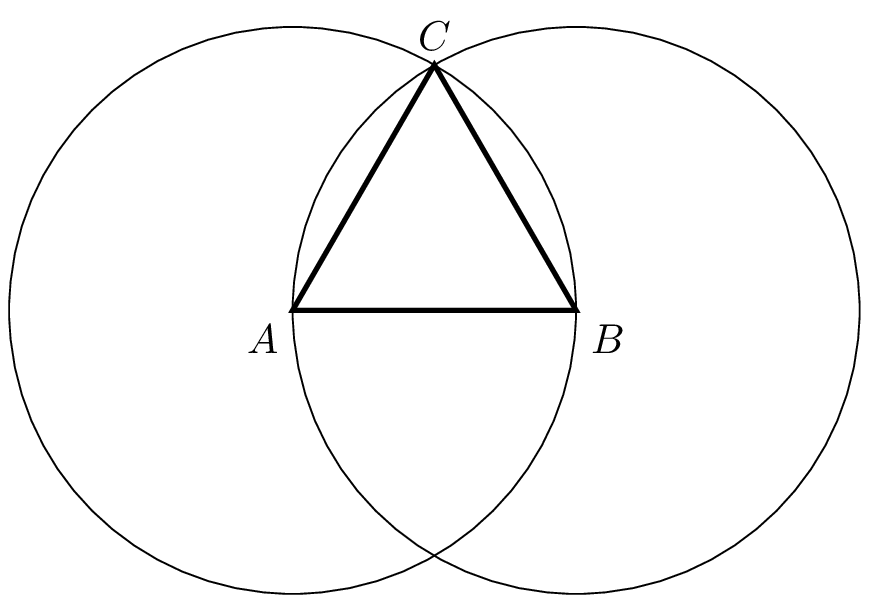
288\label{ev:IV.15}
289Let $G$ be the centre and $AD$ a diameter of the given circle.  With
290centre $D$ and radius $DG$ describe a circle meeting the given circle
291at $C$ and $E$ (Postulate 3).  Join $GC$, $GE$.  The triangle $GDC$
292has $GD = DC = CG$ (radii of equal circles), so it is equilateral,
293and $\angle DGC = 60^\circ$ (I.32).  Stepping this $60^\circ$ chord
294around the circle six times produces the regular hexagon.
295\dependson{IV.15}{I.32}
296\dependson{IV.15}{post:3}
297\dependson{IV.15}{def:I.15}
298\end{evidence}
299
300\begin{claim}[Proposition IV.16: Inscribe a regular 15-gon in a circle]
301\label{prop:IV.16}
302In a given circle to inscribe a fifteen-angled figure which shall be
303both equilateral and equiangular.
304\end{claim}
305\begin{evidence}[Proof of IV.16]
306\label{ev:IV.16}
307Inscribe a regular pentagon (IV.11) and a regular equilateral
308triangle (IV.2) in the circle, sharing a common vertex $A$.  The arc
309from $A$ to the next pentagon-vertex is $\tfrac{1}{5}$ of the circle;
310the arc from $A$ to the next triangle-vertex is $\tfrac{1}{3}$.  The
311difference is $\tfrac{1}{3} - \tfrac{1}{5} = \tfrac{2}{15}$ of the
312circle.  Bisect that arc (III.30); each half is $\tfrac{1}{15}$ of
313the circle, and stepping that chord fifteen times around gives the
314regular pentadecagon.
315\dependson{IV.16}{IV.2}
316\dependson{IV.16}{IV.11}
317\dependson{IV.16}{III.30}
318\end{evidence}
319