//
··
1% fig-i-5.tex — I.5: pons asinorum (base angles of an isoceles triangle).
2\begin{figure}[H]
3\centering
4\begin{tikzpicture}[scale=1.0, line cap=round]
5  \coordinate (A) at (0, 3);
6  \coordinate (B) at (-1.5, 0);
7  \coordinate (C) at (1.5, 0);
8  % Equal sides AB and AC, extended to F and G.
9  \coordinate (F) at ($(A)!2.0!(B)$);
10  \coordinate (G) at ($(A)!2.0!(C)$);
11  \draw[thin]      (A) -- (F);
12  \draw[thin]      (A) -- (G);
13  \draw[very thick] (B) -- (C);
14  % Points D on BF, E on CG with BD = CE.
15  \coordinate (D) at ($(B)!0.5!(F)$);
16  \coordinate (E) at ($(C)!0.5!(G)$);
17  \draw[very thick, dashed] (B) -- (E);
18  \draw[very thick, dashed] (C) -- (D);
19  % Labels.
20  \node[above]      at (A) {$A$};
21  \node[left]       at (B) {$B$};
22  \node[right]      at (C) {$C$};
23  \node[below left] at (D) {$D$};
24  \node[below right] at (E) {$E$};
25  \node[below left] at (F) {$F$};
26  \node[below right] at (G) {$G$};
27\end{tikzpicture}
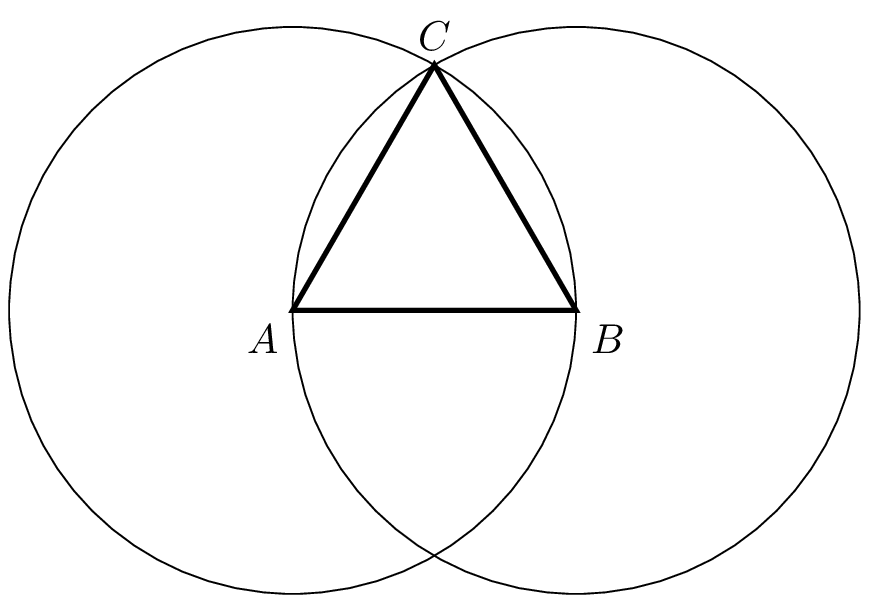
28\caption{Proposition I.5. With $AB = AC$ and $BD = CE$ on the extensions,
29triangles $ABE$ and $ACD$ are congruent (SAS, by I.4), whence the base
30angles $\angle ABC = \angle ACB$.}
31\label{fig:I.5}
32\end{figure}
33