To construct a square equal to a given rectilineal figure.
Proof
Let A be the given rectilineal figure. By Proposition I.45,
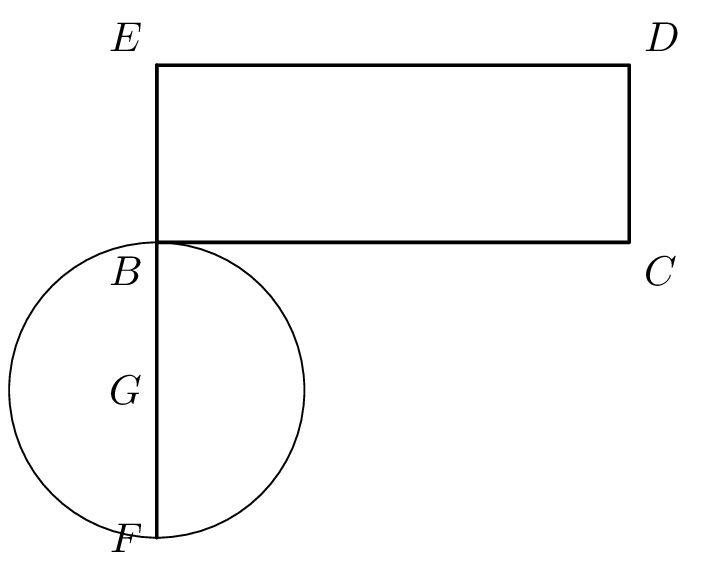
construct a parallelogram BCDE equal in area to A, with the
parallelogram's angles right (apply I.46 on one of its sides if
necessary so it is a rectangle). If BE=ED then BCDE is
already a square and the construction is complete. Suppose
BE>ED; the case BE<ED is symmetric.
Produce BE to F, laying off EF=ED on the produced line
(I.3). Bisect BF at G (I.10). With centre G and radius
GB=GF describe the semicircle BHF above BF. Produce DE
to meet the semicircle at H.
Join GH; then GH is a radius and equals GF. Apply II.5 to
BF bisected at G and cut at E: BE⋅EF+EG2=GF2=GH2. By I.47 in the right triangle GEH (right angle at E
because EH⊥BF): GH2=EG2+EH2. Subtract EG2
from both expressions (Common Notion 3): BE⋅EF=EH2.
But EF=ED, so BE⋅ED=EH2; the square on EH equals
the rectangle BCDE, which equals the original figure A.
Figure
Proposition II.14. Reduce the given rectilineal figure to rectangle BCDE (I.45). Extend BE to F with EF=ED; bisect BF