1cff-version: 1.2.0
2message: "If you use this rrxiv encoding of Euclid's Elements, please cite as below."
3type: article
4title: "Euclid's Elements, encoded as an rrxiv paper"
5authors:
6  - name: "rrxiv Project"
7date-released: 2026-05-01
8license: CC-BY-4.0
9url: "https://github.com/random-walks/rrxiv-paper-euclid-elements"
10keywords:
11  - Euclid
12  - Elements
13  - geometry
14  - rrxiv
15  - reproducibility
16  - claim graph
17references:
18  - type: book
19    title: "The Thirteen Books of Euclid's Elements"
20    authors:
21      - family-names: "Heath"
22        given-names: "Thomas L."
23    year: 1908
24    publisher: "Cambridge University Press"
25    notes: "Public domain. The translations in this encoding follow Heath with light modernisation."
26
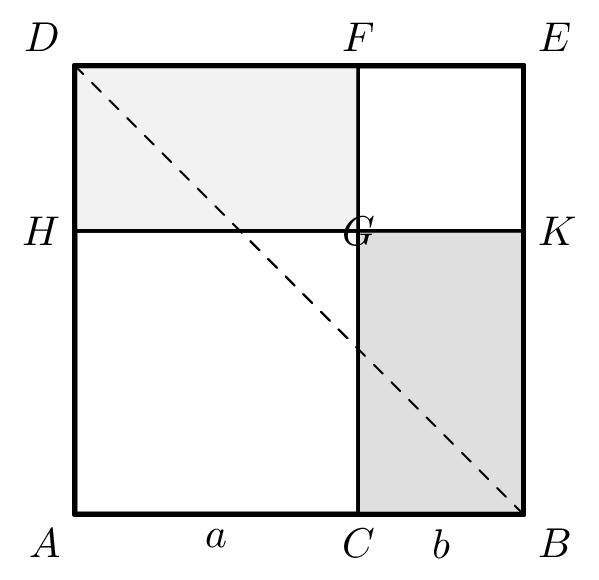
draw
CGF
parallel to either
AD
or
BE
(I.31), meeting
BD
at
G
and
DE
at
F
. Through
G
draw
HK
parallel to either
AB
or
DE
(I.31), meeting
AD
at
H
and
BE
at
K
.
Since
CF
is parallel to
AD
and
BD
falls on them, the exterior
angle
∠BGC
equals the interior and opposite
∠BDA
(I.29). But
∠BDA=∠DBA
since
BA=AD
(I.5 applied
to the isoceles right triangle inside the square). Hence
∠BGC=∠GBC
, so
BC=CG
(I.6), and therefore
CBKG
is equilateral. Since it has a right angle at
B
, it is a square
on
CB
(Definition I.22). By the same reasoning
HDFG
is the
square on
HD=AC
.
The complements
AGHD
and
GFBK
in the square
ADEB
are equal
rectangles by I.43; each is contained by
AC
and
CB
(since
AH=AC
,
HG=CB
, etc.), so each is the rectangle on
AC
,
CB
.
The four pieces sum to the whole (Common Notion 2):
\[
AB^2 \;=\; AC^2 + CB^2 + 2\cdot(AC\cdot CB),
\]
which is
(a+b)2=a2+2ab+b2
in geometric form.
Figure
Proposition II.4. The square ADEB on AB=a+b is decomposed by the parallels CF∥AD and HK∥AB into the square HDFG on AC=a, the square CBKG on CB=b, and two equal rectangles AGHD and GFBK (by I.43), each equal to a⋅b.