1% common-notions.tex — Euclid's five common notions (axioms of magnitudes).
23\section*{Common Notions}
4\label{sec:common-notions}
56\begin{rrxivremark}[Common Notion~1]
7\label{cn:1}
8Things which are equal to the same thing are also equal to one another.
9\end{rrxivremark}
1011\begin{rrxivremark}[Common Notion~2]
12\label{cn:2}
13If equals be added to equals, the wholes are equal.
14\end{rrxivremark}
1516\begin{rrxivremark}[Common Notion~3]
17\label{cn:3}
18If equals be subtracted from equals, the remainders are equal.
19\end{rrxivremark}
2021\begin{rrxivremark}[Common Notion~4]
22\label{cn:4}
23Things which coincide with one another are equal to one another.
24\end{rrxivremark}
2526\begin{rrxivremark}[Common Notion~5]
27\label{cn:5}
28The whole is greater than the part.
29\end{rrxivremark}
30
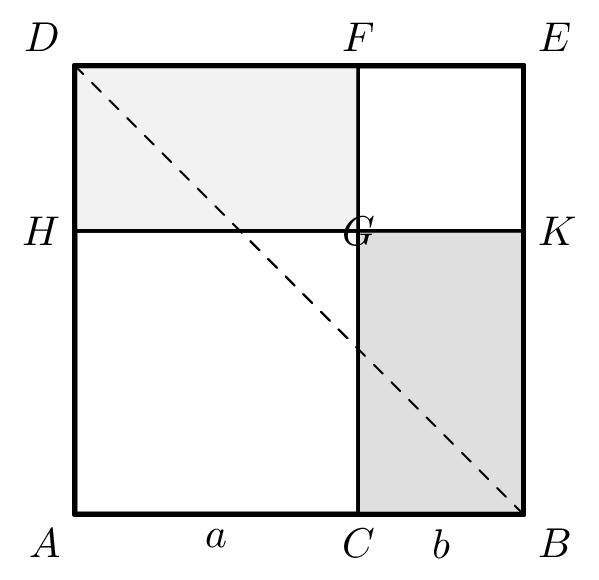
draw
CGF
parallel to either
AD
or
BE
(I.31), meeting
BD
at
G
and
DE
at
F
. Through
G
draw
HK
parallel to either
AB
or
DE
(I.31), meeting
AD
at
H
and
BE
at
K
.
Since
CF
is parallel to
AD
and
BD
falls on them, the exterior
angle
∠BGC
equals the interior and opposite
∠BDA
(I.29). But
∠BDA=∠DBA
since
BA=AD
(I.5 applied
to the isoceles right triangle inside the square). Hence
∠BGC=∠GBC
, so
BC=CG
(I.6), and therefore
CBKG
is equilateral. Since it has a right angle at
B
, it is a square
on
CB
(Definition I.22). By the same reasoning
HDFG
is the
square on
HD=AC
.
The complements
AGHD
and
GFBK
in the square
ADEB
are equal
rectangles by I.43; each is contained by
AC
and
CB
(since
AH=AC
,
HG=CB
, etc.), so each is the rectangle on
AC
,
CB
.
The four pieces sum to the whole (Common Notion 2):
\[
AB^2 \;=\; AC^2 + CB^2 + 2\cdot(AC\cdot CB),
\]
which is
(a+b)2=a2+2ab+b2
in geometric form.
Figure
Proposition II.4. The square ADEB on AB=a+b is decomposed by the parallels CF∥AD and HK∥AB into the square HDFG on AC=a, the square CBKG on CB=b, and two equal rectangles AGHD and GFBK (by I.43), each equal to a⋅b.