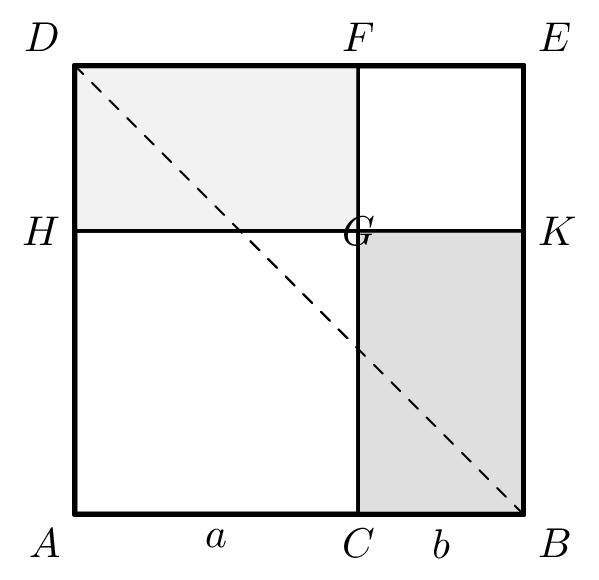
(I.5 applied
to the isoceles right triangle inside the square). Hence
∠BGC=∠GBC
, so
BC=CG
(I.6), and therefore
CBKG
is equilateral. Since it has a right angle at
B
, it is a square
on
CB
(Definition I.22). By the same reasoning
HDFG
is the
square on
HD=AC
.
The complements
AGHD
and
GFBK
in the square
ADEB
are equal
rectangles by I.43; each is contained by
AC
and
CB
(since
AH=AC
,
HG=CB
, etc.), so each is the rectangle on
AC
,
CB
.
The four pieces sum to the whole (Common Notion 2):
\[
AB^2 \;=\; AC^2 + CB^2 + 2\cdot(AC\cdot CB),
\]
which is
(a+b)2=a2+2ab+b2
in geometric form.
Figure
Proposition II.4. The square ADEB on AB=a+b is decomposed by the parallels CF∥AD and HK∥AB into the square HDFG on AC=a, the square CBKG on CB=b, and two equal rectangles AGHD and GFBK (by I.43), each equal to a⋅b.