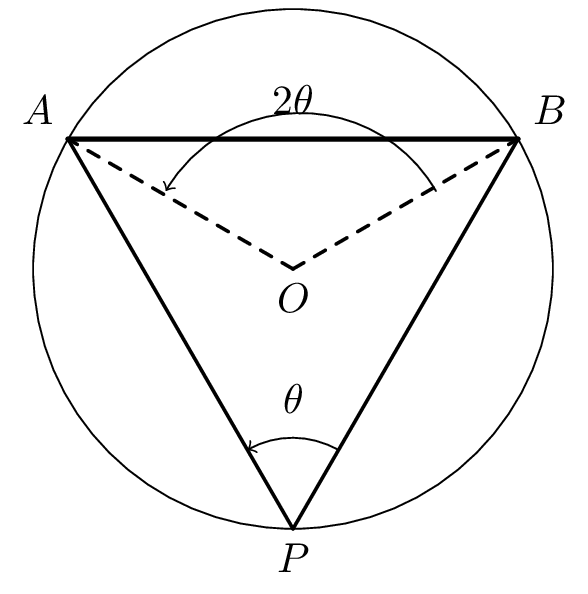
In a circle the angle at the centre is double of the angle at the circumference, when the angles have the same circumference as base.
Proof
Let ∠BEC be the angle at the centre E and ∠BAC
the angle at the circumference, both subtending the arc BC.
Join AE and produce to F on the far side of the circle.
In △EAB: EA=EB (radii), so by I.5, ∠EAB=∠EBA. By I.32 (exterior angle of a triangle), ∠BEF=∠EAB+∠EBA=2⋅∠EAB. Similarly in
△EAC: ∠CEF=2⋅∠EAC.
Adding (Common Notion 2): ∠BEC=∠BEF+∠CEF=2⋅(∠EAB+∠EAC)=2⋅∠BAC. (Heath
handles the case where A lies on the arc opposite BC from E
via a subtraction instead of an addition; the result is the same.)
Figure
Proposition III.20. The central angle ∠AOB is twice the inscribed angle ∠APB subtending the same arc AB. Corollary: all inscribed angles on the same arc are equal.