1cff-version: 1.2.0
2message: "If you use this rrxiv encoding of Euclid's Elements, please cite as below."
3type: article
4title: "Euclid's Elements, encoded as an rrxiv paper"
5authors:
6  - name: "rrxiv Project"
7date-released: 2026-05-01
8license: CC-BY-4.0
9url: "https://github.com/random-walks/rrxiv-paper-euclid-elements"
10keywords:
11  - Euclid
12  - Elements
13  - geometry
14  - rrxiv
15  - reproducibility
16  - claim graph
17references:
18  - type: book
19    title: "The Thirteen Books of Euclid's Elements"
20    authors:
21      - family-names: "Heath"
22        given-names: "Thomas L."
23    year: 1908
24    publisher: "Cambridge University Press"
25    notes: "Public domain. The translations in this encoding follow Heath with light modernisation."
26
. Produce
CA
to
F
in the direction of
A
(Postulate 2), and lay off
AF
on
CA
produced so that
EF=EB
(I.3, taking
EB
as
the standard length). On
AF
describe the square
FGHA
(I.46);
produce
GH
to meet
CD
at
K
.
Then by II.6 applied to
CF
bisected at
A
with extension
AF
,
the rectangle on
CF
,
FA
together with the square on
EA
equals
the square on
EF
. But
EF=EB
, so this rectangle plus square
on
EA
equals the square on
EB
, which by I.47 (in
△ABE
, right-angled at
A
) equals the square on
EA
plus the square on
AB
. Subtracting the square on
EA
from both
sides (Common Notion 3):
\[
CF \cdot FA \;=\; AB^2.
\]
The rectangle
CK
on
CF
,
FA
(=
CF⋅FG
since
FG=FA
)
equals the square on
AB
. Subtracting the common rectangle on
FA
,
AH
from both, the square
FGHA
on
FA
equals the rectangle
HK
on
HD
and
DK=AB−AH
. Setting
AH=AF
on
AB
(point
H
on
AB
with
AH=AF
) gives the desired section:
AB⋅HB=AH2
.
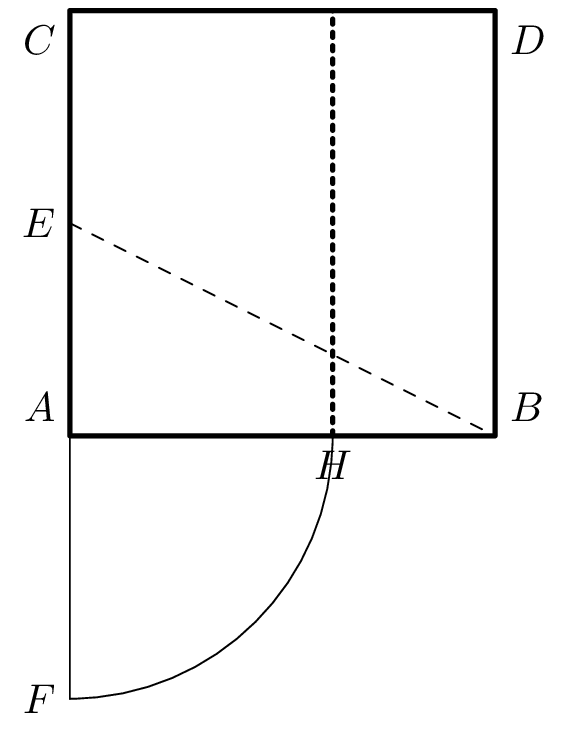
Figure
Proposition II.11. Square ABDC on AB; midpoint E of AC; F on the extension of AC with EF=EB. Then AH=AF cuts AB in the desired ratio: AB⋅HB=AH2. This is the golden section.