1% common-notions.tex — Euclid's five common notions (axioms of magnitudes).
23\section*{Common Notions}
4\label{sec:common-notions}
56\begin{rrxivremark}[Common Notion~1]
7\label{cn:1}
8Things which are equal to the same thing are also equal to one another.
9\end{rrxivremark}
1011\begin{rrxivremark}[Common Notion~2]
12\label{cn:2}
13If equals be added to equals, the wholes are equal.
14\end{rrxivremark}
1516\begin{rrxivremark}[Common Notion~3]
17\label{cn:3}
18If equals be subtracted from equals, the remainders are equal.
19\end{rrxivremark}
2021\begin{rrxivremark}[Common Notion~4]
22\label{cn:4}
23Things which coincide with one another are equal to one another.
24\end{rrxivremark}
2526\begin{rrxivremark}[Common Notion~5]
27\label{cn:5}
28The whole is greater than the part.
29\end{rrxivremark}
30
. Produce
CA
to
F
in the direction of
A
(Postulate 2), and lay off
AF
on
CA
produced so that
EF=EB
(I.3, taking
EB
as
the standard length). On
AF
describe the square
FGHA
(I.46);
produce
GH
to meet
CD
at
K
.
Then by II.6 applied to
CF
bisected at
A
with extension
AF
,
the rectangle on
CF
,
FA
together with the square on
EA
equals
the square on
EF
. But
EF=EB
, so this rectangle plus square
on
EA
equals the square on
EB
, which by I.47 (in
△ABE
, right-angled at
A
) equals the square on
EA
plus the square on
AB
. Subtracting the square on
EA
from both
sides (Common Notion 3):
\[
CF \cdot FA \;=\; AB^2.
\]
The rectangle
CK
on
CF
,
FA
(=
CF⋅FG
since
FG=FA
)
equals the square on
AB
. Subtracting the common rectangle on
FA
,
AH
from both, the square
FGHA
on
FA
equals the rectangle
HK
on
HD
and
DK=AB−AH
. Setting
AH=AF
on
AB
(point
H
on
AB
with
AH=AF
) gives the desired section:
AB⋅HB=AH2
.
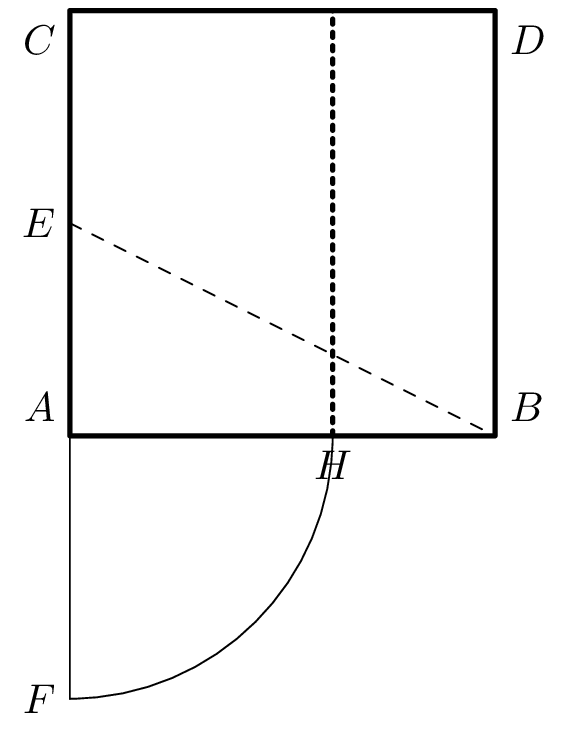
Figure
Proposition II.11. Square ABDC on AB; midpoint E of AC; F on the extension of AC with EF=EB. Then AH=AF cuts AB in the desired ratio: AB⋅HB=AH2. This is the golden section.