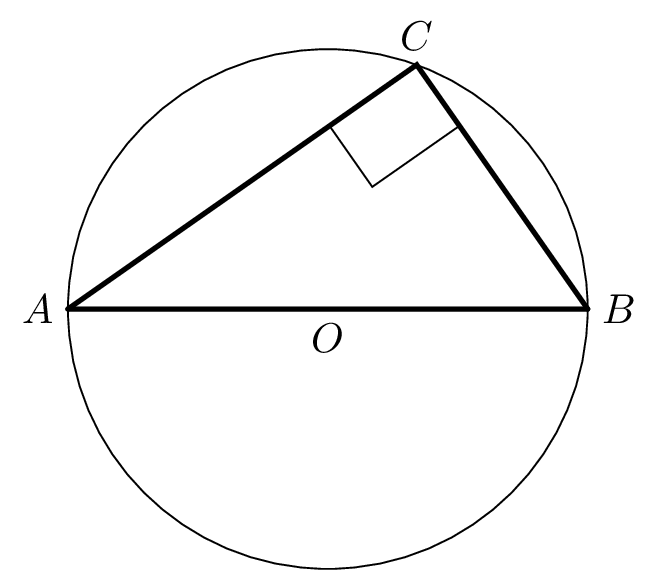
In a circle the angle in the semicircle is right, that in a greater segment less than a right angle, and that in a less segment greater than a right angle.
Proof
Let AB be a diameter of the circle with centre O, and C any
point on the circle other than A, B. Join OC, AC, BC.
Since OA=OC (radii), △OAC is isoceles, so by I.5,
∠OAC=∠OCA. Similarly △OBC is isoceles
with ∠OBC=∠OCB. By I.32, the angles of
△ABC sum to two right angles:
\[
\angle OAC + \angle OBC + \angle ACB \;=\; \text{two right angles.}
\]
But ∠ACB=∠OCA+∠OCB=∠OAC+∠OBC
by the isoceles equalities. Substituting, 2⋅∠ACB=
two right angles, so ∠ACB is right.
For inscribed angles in segments greater than a semicircle, the
arc is less than a semicircle, so by III.20 the inscribed angle is
half a central angle less than two right angles — hence less than
a right angle. The lesser-segment case is symmetric.
Figure
Proposition III.31. For any point C on the circle (not at A or B), the inscribed angle ∠ACB subtending the diameter AB is a right angle. Proof: by I.5 applied to the two isoceles triangles OAC and OCB